Your first purchase
“There is no second best.”Michael Saylor, post on X, October 8, 2021This page in the book: yourbitcoinbasics.com/ch9
Bitcoin, right now
No price chart here on purpose. Chapter 6 covers price.
By the end of Chapter 9
Do it on your phone or laptop
- Purpose, plan, price. About 15 minutes, on a phone or laptop. You will not buy anything today.
- Write one sentence that begins “I am interested in owning bitcoin because.” If the sentence will not come, that is useful information, and rereading Chapter 6 may supply it.
- Write a plan in numbers: how much, how often, from which account. Then convert the amount to sats at today’s price using the converter at yourbitcoinbasics.com/ch9.
- Open the fee pages of two platforms, one bitcoin-only and one multi-coin, from the examples in this chapter or any others. Find three things on each: the fee on a $50 bank-funded purchase, whether you can withdraw to your own wallet, and how long a new deposit is held. Write the six answers side by side.
- Fill in the volatility contract. Sign it. Photograph it.
Open one bitcoin-only platform and one that sells many coins. On each, find three things: the fee on a $50 bank-funded purchase, whether you can withdraw to your own wallet, and how long a new deposit is held. Fee pages move, so start at the company’s own site and look for Fees or Pricing, usually at the bottom of the page. Never use a search ad.
- River · Bitcoin only
- Swan · Bitcoin only
- Strike · Bitcoin only
- Coinbase · Many coins
- Kraken · Many coins
Examples, not recommendations. I have no financial relationship with any of them.
Fill it in here, or print a blank one and fill it in by hand. Then sign it, photograph it, and keep the photo where you keep your wallet app. Nothing you type leaves this device.
The back of the contract: four answers before you buy
My volatility contract
- I will read Chapters 6, 10, and 11 before I spend a dollar.
- I am buying because .
- I will buy dollars every , from account, and I will not change the amount because of the price.
- I will only use money whose loss would change nothing about my next years.
- I will not borrow to buy. No leverage, no credit card, no loan, no exception.
- When the price falls by half, and it has four times, I will .
- I will check the price no more than times a week, and I will tell one person I trust what I own and where the instructions are.
Name Signed ____________________ Date
- What I am buying:
- What I expect from it:
- Why it would go up:
- Over what time frame:
From Your Bitcoin Basics, Chapter 9 · yourbitcoinbasics.com/ch9 · Education, not advice.
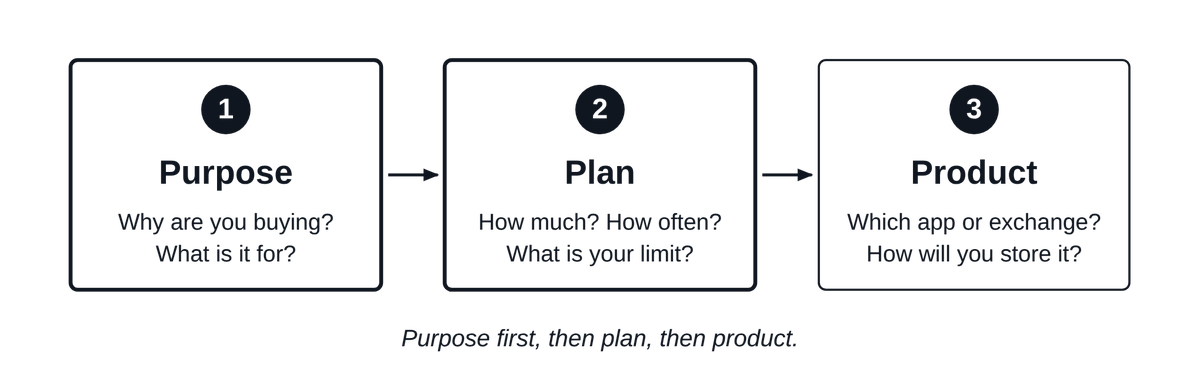
Sorted by the five ways in this chapter. Checked against the October 2026 draft of the book. Every one is an example, not a recommendation; I have no financial relationship with any of them. Purpose first, then plan, then product. If a salesman runs that order backward, walk.
An exchange
A business that sells bitcoin to the public at the going price and checks your identity first. Most first purchases happen here.
- Swan · Bitcoin only, built around scheduled purchases
- River · Bitcoin only, built around scheduled purchases
- Strike · Bitcoin only, links to a U.S. bank account
- Coinbase · Many coins; larger and older
- Kraken · Many coins; larger and older
- Cash App · Already on many phones; sells bitcoin and nothing else in crypto
Check before you use it: The fee on a $50 bank-funded purchase, whether you can withdraw to your own wallet, and how long a new deposit is held.
A peer-to-peer trade
A purchase from another person, not a business. These platforms introduce buyers to sellers and hold the bitcoin in escrow until the cash arrives. Legal for your own use; a stranger is still a stranger.
- Bisq · Software you run yourself; no company in the middle
- Peach · A phone app for cash and bank trades
- HodlHodl · A website with escrow
Check before you use it: Whether the escrow is real, how disputes are settled, and that the gain is still taxable.
A Bitcoin ATM
Feed in cash, show it a wallet address, and it sends bitcoin. Convenient, and fees often run above 10%. Scammers send victims to these machines because the cash is gone the moment it goes in.
- No names here on purpose. Any machine is the same machine.
Check before you use it: The posted fee, which is often not posted. If anyone on a phone is telling you to use one, that is the Chapter 11 checklist in action: hang up.
Earning it
Part of a paycheck, an invoice, or a card that pays a percentage back in sats instead of points. You never buy anything.
Check before you use it: What the conversion rate and fee are, and where the sats land: in an account the company holds, or in a wallet you hold.
An exchange-traded fund
Shares in a fund that holds bitcoin, bought in an ordinary brokerage or retirement account. You own a claim on the fund. You cannot withdraw, spend, or send the bitcoin.
Check before you use it: The yearly fee, and that this is bitcoin’s price without bitcoin’s properties, which Chapter 13 explains.
Which one? A small scheduled purchase points to a bitcoin-only exchange. A one-time larger purchase, to a full exchange. Money already inside a retirement account, to the fund. No bank account, to a peer-to-peer trade. The sixth way, mining, is an industrial business now; Chapter 4 covered it. The full list of products named in the book is at /tools.
Did it stick?
Rate yourself: yes, mostly, or not yet. Not yet means reread that section. It does not mean you failed.
- I can name the five ways to buy bitcoin and the way of getting a cup of coffee that matches each one.
- I can say where every dollar of a thousand-dollar purchase goes, including the fee, the spread, and the network fee.
- I can explain what an exchange knows about me and what the public ledger shows.
- I can explain why buying a fixed amount on a schedule is a behavior and not a prediction.
- I have written my own rules and signed the page.
A coworker says, “I’m putting my whole tax refund into bitcoin on Friday, and my brother says I can borrow against it on the app to double up.” What do you say?
Say your answer out loud first. Then open the model response.
Show the model response
Slow down, and please do not borrow. Your whole refund is money you might need, and borrowing against bitcoin to buy more means a fall can force a sale at the bottom, at a moment the lender chooses. Bitcoin has fallen more than 75% four times. Write one sentence about why you want it. Then pick an amount you could lose without it changing your life, and buy that, on a schedule. A financial advisor can help you decide whether any of the refund belongs there.
“Isn’t dollar-cost averaging just a way to make buying something risky feel responsible?”
My answer
Partly, yes, and the people who sell it as a strategy owe you a fuller answer than they usually give. Buying on a schedule does nothing to the risk of the thing you are buying. If bitcoin went to zero, a schedule would buy zero more slowly. Vanguard’s study, which Chapter 6 described, found that a lump sum beat spreading it out about two-thirds of the time, because markets rose more often than they fell. The lower average cost in my 4-month example is arithmetic, and arithmetic works against you in a market that only rises.
The schedule changes the buyer. It makes the amount small enough to ignore, removes the daily decision that loss aversion gets wrong, and turns a purchase into a habit that survives a bad year. Those are claims about you, and they hold up.
Want a second opinion with sources? The Bitcoin Evidence Base answers claims like this one.
Watch, read, explore
Step-by-step wallet videos
Short screen recordings of setting up common wallets. Pause and follow along.BTC Sessions on YouTubeRead · 10 minDigital assets and your taxes
The IRS’s own page. Read it before your first purchase, not after.irs.govProducts and services named are examples, not recommendations. I have no financial relationship with any of them.
The 21 notes for Chapter 9
- FinCEN, “Application of FinCEN’s Regulations to Certain Business Models Involving Convertible Virtual Currencies,” FIN-2019-G001, 2019 (a person trading for personal use is not a money transmitter; a business may be).
- Federal Trade Commission, Data Spotlight, “Bitcoin ATMs: A payment portal for scammers,” September 3, 2024, ftc.gov, retrieved September 2026 (reported losses of over $110 million in 2023, nearly tenfold the 2020 figure). Fees: Iowa Attorney General, press release on suits against Bitcoin Depot and CoinFlip, February 26, 2025, iowaattorneygeneral.gov, retrieved September 2026 (fees of about 23% and 21% of each transaction); Massachusetts Attorney General, press release on suit against Bitcoin Depot, February 3, 2026, mass.gov, retrieved September 2026 (markups of 15 to 50%).
- U.S. Securities and Exchange Commission, approval order for spot bitcoin exchange-traded products, January 10, 2024.
- FinCEN, “Application of FinCEN’s Regulations to Persons Administering, Exchanging, or Using Virtual Currencies,” FIN-2013-G001, 2013; 31 CFR 1022.210, anti-money laundering program requirements for money services businesses, including customer identification procedures, ecfr.gov, retrieved September 2026.
- River, “What are River’s fees?” support.river.com, retrieved September 2026 (1.00% on one-time purchases up to $1 million; no fee on recurring purchases after the first week); Swan, “Fees,” swanbitcoin.com, retrieved September 2026 (1% on purchases, effective July 1, 2025); Kraken, “FAQs about buying instantly,” support.kraken.com, retrieved September 2026 (1% plus a spread, with payment-method fees shown at checkout); Coinbase, “Coinbase pricing and fees disclosures,” help.coinbase.com, retrieved September 2026 (fee and spread shown on the trade preview screen); Coinbase, “USD ACH Deposits,” help.coinbase.com, retrieved September 2026 (ACH transfers take three to five business days, and funds cannot be withdrawn until received).
- Bitcoin average transaction fee, daily series from Blockchain.com via YCharts, retrieved September 2026 (daily averages between about $0.17 and $0.58 from August through late September 2026); live fee estimates at mempool.space.
- Internal Revenue Service, Notice 2014-21, 2014 (virtual currency treated as property).
- Internal Revenue Service, “Gross Proceeds and Basis Reporting by Brokers and Determination of Amount Realized and Basis for Digital Asset Transactions,” T.D. 10000, 89 FR 56480, July 9, 2024; IRS Fact Sheet FS-2024-23, June 2024, irs.gov, retrieved September 2026 (gross proceeds reported for transactions on or after January 1, 2025; basis for certain transactions on or after January 1, 2026); Form 1099-DA.
- Satoshi Nakamoto, “Bitcoin: A Peer-to-Peer Electronic Cash System,” 2008, section 10, “Privacy.” Divisibility to 100 million units is set in the Bitcoin software, not the paper.
- Brigitte Madrian and Dennis Shea, “The Power of Suggestion: Inertia in 401(k) Participation and Savings Behavior,” Quarterly Journal of Economics, 2001; Richard Thaler and Cass Sunstein, Nudge, Yale University Press, 2008.
- Mt. Gox Co., Ltd., civil rehabilitation petition, Tokyo District Court, February 28, 2014 (about 850,000 bitcoin reported missing, about 750,000 of them customers’); Mt. Gox announcement of March 20, 2014 that about 200,000 bitcoin had been found, leaving about 650,000 missing, as reported by CBS News and the Associated Press, March 21, 2014, cbsnews.com, retrieved September 2026.
- FTX Trading Ltd., Chapter 11 petition, U.S. Bankruptcy Court for the District of Delaware, November 11, 2022; FTX debtors, second stakeholder presentation, March 2, 2023 (about $2.7 billion of customer assets identified against $11.6 billion of customer balances, a shortfall of about $8.9 billion), as reported by Securities Docket, March 3, 2023, securitiesdocket.com, retrieved September 2026.
- Celsius Network, notice pausing all withdrawals, swaps and transfers, June 12, 2022; Chapter 11 petition, U.S. Bankruptcy Court for the Southern District of New York, July 13, 2022, as summarized by the Vermont Department of Financial Regulation consumer alert, 2022, dfr.vermont.gov, retrieved September 2026; the company left bankruptcy and began paying creditors under its plan on January 31, 2024, without reopening withdrawals.
- United States v. Frank Richard Ahlgren III, U.S. District Court for the Western District of Texas: U.S. Department of Justice, press release on guilty plea, September 12, 2024, and sentencing to two years in prison, December 12, 2024, justice.gov, retrieved September 2026; Congressional Research Service, Legal Sidebar LSB11353, “United States v. Ahlgren: A Study in Lost Cryptocurrency Tax Revenue,” everycrsreport.com, retrieved September 2026 (Ahlgren sold bitcoin for cash in person, moved coins through mixers and multiple wallets, and deposited cash in amounts just under $10,000).
- U.S. Constitution, Fourth Amendment; United Nations, Universal Declaration of Human Rights, Article 12, 1948; Harper v. Werfel, No. 23-1565, U.S. Court of Appeals for the First Circuit, September 24, 2024, certiorari denied June 30, 2025, No. 24-922.
- Daniel Kahneman and Amos Tversky, “Prospect Theory: An Analysis of Decision under Risk,” Econometrica, 1979; Amos Tversky and Daniel Kahneman, “Advances in Prospect Theory,” Journal of Risk and Uncertainty, 1992 (loss-aversion coefficient near two).
- Glassnode, “A Bear of Historic Proportions,” The Week On-chain, June 2022, research.glassnode.com, retrieved September 2026 (bear-market lows of 75 to 84% below the prior high in 2015 and 2018); the 2021 to 2022 decline, from a November 2021 high of $68,906 to a November 2022 low of $15,517, or 77.5%, as reported by Yahoo Finance, 2026, retrieved September 2026; the 2011 decline, from about $32 in June 2011 to about $2 in November 2011 on Mt. Gox, about 93% (Coin Metrics daily reference price, as in the Chapter 6 notes).
- Bybt (now Coinglass) liquidation data, as reported by CoinDesk, “Bitcoin Drops Below $31K Before Rebounding; $8B in Liquidations Triggered,” May 19, 2021, coindesk.com, retrieved September 2026 ($8 billion of futures positions liquidated in 24 hours).
- Peter Gollwitzer, “Implementation Intentions: Strong Effects of Simple Plans,” American Psychologist, 1999; Peter Gollwitzer and Paschal Sheeran, meta-analysis, Advances in Experimental Social Psychology, 2006.
- Anatoly Shtekhman, Christos Tasopoulos and Brian Wimmer, “Dollar-cost averaging just means taking risk later,” Vanguard Research, July 2012 (lump-sum investing outperformed a 12-month dollar-cost average in about two-thirds of rolling 10-year periods: 67% in the United States, 67% in the United Kingdom and 66% in Australia, for 60/40 portfolios).
- Brad Barber and Terrance Odean, “Boys Will Be Boys: Gender, Overconfidence, and Common Stock Investment,” Quarterly Journal of Economics 116, no. 1 (2001): men traded 45% more than women and earned lower net returns.
Found a broken link or a mistake? Write to ybbook@proton.me and I will fix it.