
Why the price of bitcoin rises and falls
“Bitcoin is the hardest money ever invented: growth in its value cannot possibly increase its supply; it can only make the network more secure.”Saifedean Ammous, The Bitcoin Standard, 2018This page in the book: yourbitcoinbasics.com/ch6
Bitcoin, right now
No price chart here on purpose. Chapter 6 covers price.
By the end of Chapter 6
Do it on your phone or laptop
- Run the history yourself. Fifteen minutes, on a phone or laptop. Go to yourbitcoinbasics.com/ch6 and open the DCA calculator. Pick a start date. Try the month you first heard the word Bitcoin, which you wrote down at the start of this chapter. Set the amount to $25 a month, which is a number chosen to be boring. Run it to today.
- Look at three things. The total put in. The value today. And the line the calculator marks as the worst stretch: the months when the account was furthest below what had been put in. Write down how many months that stretch lasted and how far down it went.
- Now answer one question, privately: would you have kept buying through that stretch? Do not answer the way you wish you would. Answer the way you actually behaved the last time something you owned dropped. There is no score for this. The point is to meet the drawdown on paper before you meet it in life.
- If you have more time, open Nakamoto Portfolio (nakamotoportfolio.com) and run the same start date with 1% of an ordinary stock-and-bond mix moved into bitcoin. Look at what happened to the swing and the result.
- Size it up. Five minutes. Go to companiesmarketcap.com/assets-by-market-cap and find bitcoin on the list of the world’s largest assets, next to gold, silver, and the biggest companies. Write down its rank and its market cap today, and the figure for gold. Then come back in a year and do it again. The ranking will have moved. The arithmetic behind it, price x coins, will not.
Total put in What it was worth Worst stretch
The monthly prices behind this run
| Month | Price paid | Total put in | Worth |
|---|
Loading the price history…
$50 a month from January of each year, valued at about $83,000 a bitcoin in October 2026.
| Started | Put in | Holds | Worth |
|---|---|---|---|
| 2015 | about $7,100 | about 4 BTC | about $330,000 |
| 2018 | about $5,300 | about 0.3 BTC | about $27,000 |
| 2020 | about $4,100 | about 0.14 BTC | about $11,500 |
| 2024 | about $1,650 | about 0.022 BTC | about $1,800 |
Did it stick?
Rate yourself: yes, mostly, or not yet. Not yet means reread that section. It does not mean you failed.
- I can explain why a fixed supply makes the price rise over long windows and swing hard over short ones.
- I can name the four largest drawdowns by year and say what happened after each one.
- I can describe what $50 a month looked like from 2015 to 2026 and say where to check the figures.
- I can name the three kinds of large holders that arrived after 2020 and say why that is context and not a reason.
- I can state the greater-fool objection fairly and give both halves of the answer.
Your brother-in-law says, “It’s at $83,000. The people who bought at a $5 got rich. Anyone buying now is just the last one holding the bag.” What do you say?
Say your answer out loud first. Then open the model response.
Show the model response
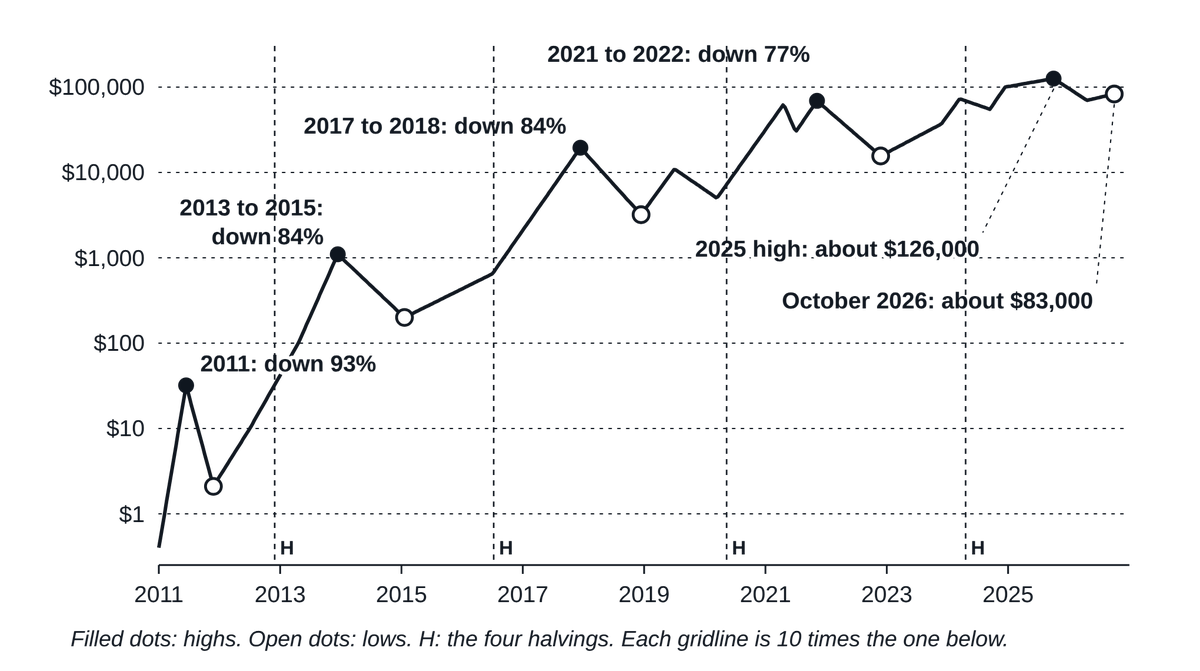
Some people bought at $5 and sold at $10. Others bought near $69,000 in 2021 and watched it fall to about $15,600 a year later. Every high so far was later passed, but that is history, not a promise. It is also not a scheme with someone at the top: when you buy, you buy from a seller at a price you both agree on. The real question is time. Only someone who could leave the money alone through a 50% fall, for years, has any business buying.
“Isn’t this a greater-fool story? Bitcoin pays no interest and no dividend. The only reason the price goes up is that someone else will pay more. Doesn’t that make it a game of finding the next buyer?”
My answer
That is the strongest objection in this book, and the answer has two halves.
The first half concedes the point. Bitcoin produces nothing. It pays no rent, earns no profit, makes no tangible product, and pays no coupon. Its price in dollars is entirely what the next person will pay, and if no one wants it, it is worth nothing. That is true. It is also true of gold, of a dollar bill, of a painting, and of a house in a town where everyone has left. Gold has some use in jewelry and industry, and the dollar is demanded for taxes, but most of what each is worth is still what the next person will pay. None of those things has value in itself. They have value because people want them for something. So the greater-fool question is really a different question: is there any reason to want bitcoin other than selling it to someone else?
The second half answers that. People use bitcoin to send money across a border in minutes without asking a bank. They use it to hold savings that no government can print more of. They use it because no one can refuse them an account. If those uses matter to no one, then the greater-fool description is correct, and the price will eventually show that. If those uses matter to more people every year, then the people holding it are not fools waiting for fools. I owe you one more concession. By my own count at the start of this chapter, most people buy bitcoin today for the number, so most of today’s demand is the kind the objection describes. The uses are real, and they are still the minority. They use something useful, and the price reflects that use.
What the record shows, through October 2026, is 15 years of more users, more holders, and more institutions at each cycle, through four crashes that should have ended a pure greater-fool game. Beanie Babies did not survive their crash. That is evidence, not proof.
Your decision. Everything in this chapter is history. Whether any of it should change what you do with your money is a question for you, and for a financial advisor who can see your whole situation. If you are near or in retirement, ask about the years, not the returns: how many years could this money sit untouched? An estate attorney belongs in the conversation once the amount is one your family would need to find. I have given you the record and the tools. The research and decision is yours to make.
Want a second opinion with sources? The Bitcoin Evidence Base answers claims like this one.
Watch, read, explore
Nakamoto Portfolio
Run any start date and see the falls along the way, not only the end result.Swan (a company that sells bitcoin)Explore · 5 minAssets by market cap
Find bitcoin, then gold. The Try it activity uses this list.companiesmarketcap.comExplore · BrowseBitcoin obituaries
Every published claim that Bitcoin is dead, with the price on the day.99BitcoinsExplore · BrowseWho holds bitcoin
Companies, funds and governments, with their holdings.bitcointreasuries.netProducts and services named are examples, not recommendations. I have no financial relationship with any of them.
The 39 notes for Chapter 6
- Historical bitcoin prices, drawdowns and rolling 4-year returns: Yahoo Finance, BTC-USD monthly price history (CoinMarketCap data), January 2015 to May 2026, finance.yahoo.com, retrieved September 2026 (December 2017 high $20,089; December 2018 low $3,191; November 2021 high $68,790; November 2022 low $15,599; October 6, 2025 high $126,198; May 2026 range $72,436 to $82,792). 2011 peak of $31.91 on June 8, 2011, and the 93% fall that followed: Bitcoin Magazine, “Anniversary of the Great Bubble of 2011,” June 2012. 2013 prices and the January 2015 low: Bitcoin.com, “Bitcoin Price History,” retrieved September 2026. The 4-year claim was checked against every 48-month window in the monthly data from January 2015 through May 2026, buying at the monthly high and selling at the monthly low; none was negative.
- U.S. Securities and Exchange Commission, statement on the approval of spot bitcoin exchange-traded products, January 10, 2024; Grayscale Investments v. SEC, 82 F.4th 1239 (D.C. Cir. August 29, 2023), vacating the SEC’s denial of Grayscale’s application as arbitrary and capricious.
- Issuance schedule and 2024 halving: Bitcoin whitepaper (Nakamoto, 2008) and bitcoin.org developer documentation; block 840,000, April 2024, reward reduced to 3.125 bitcoin, about 450 new bitcoin a day. Stock-to-flow computed from that issuance (about 164,000 new bitcoin a year against about 20 million in circulation, May 2026), giving a ratio of about 120.
- Executive Order, “Establishment of the Strategic Bitcoin Reserve and United States Digital Asset Stockpile,” The White House, March 6, 2025, whitehouse.gov, retrieved September 2026. The order states that bitcoin deposited into the reserve “shall not be sold.”
- Gold supply growth and stock-to-flow: World Gold Council, “How much gold has been mined?” (above-ground stock of 219,891 tonnes at the end of 2025) and “Gold Demand Trends: Full Year 2025” (mine production of 3,672 tonnes in 2025), gold.org, retrieved September 2026. Mine production is about 1.7% of the stock, a stock-to-flow ratio of about 60.
- M2 money stock, February 2020 to February 2022: Federal Reserve Bank of St. Louis, FRED series M2SL (about $15.4 trillion to about $21.7 trillion, an increase of about 41%), 2026.
- Nick Szabo, “Shelling Out: The Origins of Money,” 2002.
- Dollar-cost averaging figures: computed from Yahoo Finance monthly BTC-USD prices (each month’s purchase at the average of that month’s opening and closing price), $50 a month from January of the start year through September 2026, valued at $83,000 in October 2026; yourbitcoinbasics.com/ch6 DCA calculator. Monthly closes compiled by Digrin, digrin.com, from the Yahoo Finance series. Retrieved October 2026.
- Nakamoto Portfolio (Swan Research), nakamotoportfolio.com, retrieved September 2026.
- Global adoption estimate: River, “Bitcoin Adoption Report 2025,” March 2025 (about 4% of the world’s population owns bitcoin), river.com.
- Network uptime and events: two brief chain-split incidents, August 2010 (CVE-2010-5139) and March 2013 (Bitcoin Core BIP 50), together under a day of downtime since January 3, 2009; Mt. Gox bankruptcy filing, February 28, 2014; China mining ban, May to June 2021; FTX bankruptcy filing, November 11, 2022.
- Nassim Nicholas Taleb, Antifragile, Random House, 2012.
- Bitcoin obituaries count: 99Bitcoins, “Bitcoin Obituaries” (477 entries), 99bitcoins.com, retrieved September 2026.
- U.S. spot bitcoin ETF holdings: River, “Who owns the most bitcoin?” (about 1.5 million bitcoin held by ETFs, about 7% of supply, as of December 2025), river.com, retrieved September 2026. BlackRock iShares Bitcoin Trust growth: Bloomberg ETF analysis reporting IBIT as the fastest ETF ever to reach $70 billion and $80 billion in assets, June and July 2025, as reported by BeInCrypto, July 2025.
- MicroStrategy press release, August 11, 2020, and Michael Saylor’s public statements, 2020.
- Corporate holdings: Strategy Inc., Form 8-K, Exhibit 99.1, May 5, 2026, sec.gov (818,334 bitcoin as of May 3, 2026); Metaplanet, 40,177 bitcoin as of March 31, 2026, CoinDesk, April 2, 2026; count of public companies: River, “Bitcoin Adoption Report 2026,” February 2026 (194 public companies at the end of 2025), and bitcointreasuries.net (at least 154 as of April 2026); Tesla, Block, Marathon and Riot holdings: bitcointreasuries.net, retrieved September 2026.
- Government holdings: bitcointreasuries.net, government holdings page (United States 328,372; United Kingdom 61,245; Ukraine 46,351; total about 645,000), retrieved September 2026; Bhutan: Arkham Intelligence data as reported by CoinDesk, April 11, 2026 (peak of about 13,000 in October 2024, under 4,000 by April 2026); El Salvador: one bitcoin a day since November 2022, about 7,700 held, Bitcoin Magazine, June 9, 2026.
- Saxony sale: Medienservice Sachsen, “Notveräußerung von fast 50.000 Bitcoins abgeschlossen,” press release, July 16, 2024 (49,858 bitcoin sold between June 19 and July 12, 2024, for about 2.64 billion euros, an average of about 52,900 euros each), medienservice.sachsen.de, retrieved September 2026.
- Market cap: about 20 million coins in circulation at a price near $83,000, October 2026. Gold: World Gold Council above-ground stock of 219,891 tonnes at the end of 2025, at a May 2026 average price of about $4,600 an ounce, about $32 trillion. Household wealth: UBS Global Wealth Report 2025, June 2025 (about $470 trillion across 56 markets covering more than 92% of world wealth, end of 2024). Store-of-value market estimate: Mark Moss, “The Billionaire Who Predicted the Dot-Com Crash Says Bitcoin Goes to Zero,” The Mark Moss Show, YouTube, 2026, and his accompanying calculator (about $994 trillion in 2025 and about $300 trillion in 2010, across real estate, debt securities, other credit, equities, broad money, gold, and art and collectibles), retrieved October 2026.
- Terence Michael, Proof of Money: The Big Idea Behind Bitcoin, 2023.
- Saifedean Ammous, The Bitcoin Standard, Wiley, 2018.
- Carl Menger, Principles of Economics, 1871, chapter 3, on value as a judgment made by people about goods, not a property of the goods themselves (Ludwig von Mises Institute edition, 2007).
- Satoshi Nakamoto, “Bitcoin: A Peer-to-Peer Electronic Cash System,” October 31, 2008, section 6; the issuance schedule in the Bitcoin Core source code (halving every 210,000 blocks, initial subsidy of 50 bitcoin), github.com/bitcoin/bitcoin, retrieved September 2026.
- Chainalysis, “Bitcoin’s Circulating Supply,” June 2020 (about 3.7 million bitcoin estimated lost, based on coins that had not moved in five or more years); River, “How Much Bitcoin Is Gone Forever?,” September 6, 2023, updated July 2026 (3 to 4 million bitcoin; a separate River study puts about 1.6 million lost to self-custody mistakes alone), river.com, retrieved October 2026.
- iShares, “Bitcoin Volatility Guide: Trends and Insights for Investors,” 2025 (annualized volatility of about 54% as of January 31, 2025, described as having “notably declined” as the market matured), ishares.com, retrieved September 2026; S&P 500 long-run annualized volatility of roughly 15 to 20%, from the CBOE VIX historical series, cboe.com, retrieved September 2026.
- Daniel Kahneman and Amos Tversky, “Prospect Theory: An Analysis of Decision under Risk,” Econometrica 47, no. 2 (1979); Tversky and Kahneman, “Advances in Prospect Theory,” Journal of Risk and Uncertainty 5 (1992), estimating that losses are weighted about 2.25 times as heavily as equivalent gains.
- Shlomo Benartzi and Richard Thaler, “Myopic Loss Aversion and the Equity Premium Puzzle,” Quarterly Journal of Economics 110, no. 1 (1995).
- Zeke Faux, Number Go Up: Inside Crypto’s Wild Rise and Staggering Fall, Currency, 2023. Price models: PlanB, “Modeling Bitcoin’s Value with Scarcity,” March 22, 2019, medium.com; FXStreet, “Bitcoin stock-to-flow model invalidated as BTC closes 2021 below $100,000,” January 1, 2022, fxstreet.com; Galaxy Research, four-year cycle report, June 12, 2026, galaxy.com (peak of $124,824 on October 6, 2025; drawdown of 51% as of June 9, 2026); Newhedge, “Bitcoin Power Law,” newhedge.io; Timothy Peterson, “Metcalfe’s Law as a Model for Bitcoin’s Value,” Alternative Investment Analyst Review, 2018; all retrieved October 2026.
- René Girard, Deceit, Desire, and the Novel: Self and Other in Literary Structure, 1961 (English translation, Johns Hopkins University Press, 1965); for a plain-language introduction, Luke Burgis, Wanting: The Power of Mimetic Desire in Everyday Life, St. Martin’s Press, 2021.
- Harrison Hong, Jeffrey Kubik and Jeremy Stein, “Social Interaction and Stock-Market Participation,” Journal of Finance 59, no. 1 (2004): 137-163.
- Markku Kaustia and Samuli Knüpfer, “Peer Performance and Stock Market Entry,” Journal of Financial Economics 104, no. 2 (2012): 321-338 (entry rose after neighbors’ positive returns; negative returns had no matching effect).
- Girard’s distinction between destructive rivalry and imitation of a model who wants good things runs through his later work; see René Girard, Things Hidden Since the Foundation of the World, 1978 (English translation, Stanford University Press, 1987), and the discussion in Burgis, Wanting, part 2.
- New issuance: 3.125 bitcoin per block after the April 2024 halving, about 144 blocks a day, about 450 bitcoin a day; annual issuance about 164,000 against about 20.1 million in existence, about 0.8%.
- GameKyuubi, “I AM HODLING,” bitcointalk.org, December 18, 2013.
- Brad Barber and Terrance Odean, “Trading Is Hazardous to Your Wealth,” Journal of Finance 55, no. 2 (2000): households that traded most earned the lowest returns.
- Barber and Odean, “Boys Will Be Boys,” 2001, cited in Chapter 9; Fidelity Investments, 2021 Women and Investing Study, on women trading less often and holding longer.
- Kaiko Research, bitcoin 1% market depth on Binance, as reported December 20, 2025: above $600 million at the October 2025 high and under $400 million in December 2025 (retrieved October 2026).
- Vanguard Research, “Dollar-cost averaging just means taking risk later,” July 2012 (lump-sum investing beat a 12-month schedule about two-thirds of the time in U.S., U.K., and Australian markets, 1926 to 2011); bitcoin month-end closing prices, BTC-USD (Yahoo Finance data, via digrin.com): November 2021 $57,005; October 2022 $20,496; January 2023 $23,139; December 2023 $42,265; September 2026 $83,554 (retrieved October 2026).
- Ownership shares: River, “Who owns the most bitcoin in 2026?,” river.com (ETFs and funds about 1.5 million; public companies more than 1 million; private companies about 312,000; Satoshi about 968,000; lost about 1.6 million, a low estimate); governments from note 17; coins not yet mined from note 33 (retrieved October 2026). Shares are of the 21 million cap and rounded.
Found a broken link or a mistake? Write to [BOOK EMAIL] and I will fix it.