From reader to neighbor
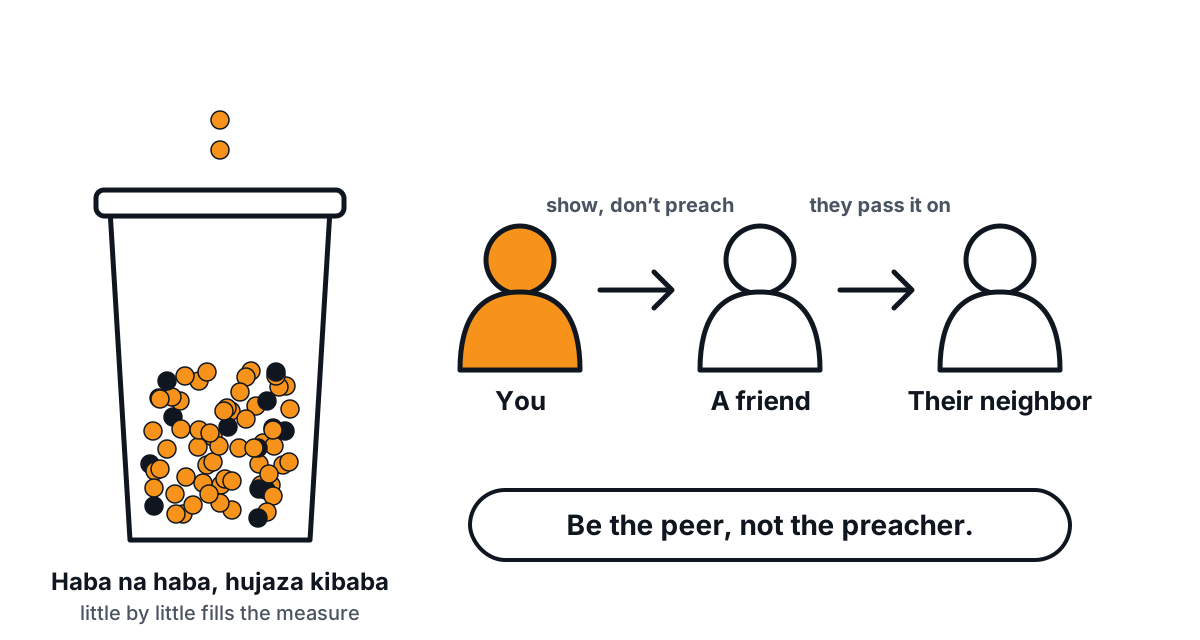
“Little by little, a little becomes a lot.”Swahili proverb, Haba na haba, hujaza kibaba, from Tanzania and the East African coast.This page in the book: yourbitcoinbasics.com/ch15
Bitcoin, right now
No price chart here on purpose. Chapter 6 covers price.
By the end of Chapter 15
Do it on your phone or laptop
- Write the plan. Fifteen minutes, on paper or your phone. Go to yourbitcoinbasics.com/ch15 for a printable version and the milestone page.
- Write today’s date and the date you expect to finish the tenth session.
- Under Learn, write which chapters you will reread, and one thing from the lists above you will read, watch, or listen to all the way through. Put a week next to each.
- Under Buy small, write an amount you could lose without noticing, or write “not yet,” which is a complete answer. Put a date next to it that falls after you have reread Chapters 10 and 11.
- Under Secure, write where the words will live and who, if anyone, will know. Put a date next to it.
- Under Share, write the name of one meetup, in person or online, and the date you will sit in the back of it. Then write one sentence you would say if someone asked what you think. Use the script if you need it.
- Find your Chapter 2 note and staple it to this page.
- After the tenth session, come back, print the milestone page, sign it, and put it with the seed phrase. You will find both again some year when you need them.
- Photograph your signed plan. This is the page the whole book was building toward.
The order of my course, one session a week or at your own pace. Write a date next to each one before you begin. The order matters more than the pace.
- 1
- 2
- 3Read Chapter 5.Do: Read the fine print in your own bank’s deposit agreement.Write: The sentence in it that surprised you.
- 4
- 5
- 6Read Chapter 10 and Chapter 11.Do: Do the restore drill with an empty wallet. Score one real message against the red flags. Run the family script.Write: The pause line, from memory.
- 7Read Chapter 12.Do: Feed a goat, or send a friend 100 sats.Write: What you paid, the sats you got, and the date.
- 8Read Chapter 13.Do: Draft your recovery letter with the template.Write: Where the letter lives, and who knows it exists.
- 9Read Chapter 14.Do: Check the ten-minute promise against the block height.Write: What else in your financial life you could check this way.
- 10Read Chapter 15.Do: The field trip: go to a meetup, in person or online, and sit in the back.Write: Your plan with dates. Then print the milestone page and sign it.
Four steps, in this order: learn, buy small, secure, share. “Not yet” is a complete answer. Nothing you type leaves this device.
My Bitcoin plan
Started · Finish by
- Learn. By .
- Buy small. On .
- Secure. By .
- Share. On . If someone asks: “”
Signed ____________________
From Your Bitcoin Basics, Chapter 15 · yourbitcoinbasics.com/ch15 · Staple your Chapter 2 note to this page.
After the tenth session, print this, sign it, and put it with your seed phrase. You will find both again some year when you need them.

This marks that
Your namefinished the ten sessions of Your Bitcoin Basics: learn, buy small, secure, share.
Nobody will ever need my seed phrase. I will never ask for anyone else’s.
Stacey Boyle, PhD · yourbitcoinbasics.com/ch15
Did it stick?
Rate yourself: yes, mostly, or not yet. Not yet means reread that section. It does not mean you failed.
- I can name the four steps of the plan, in order, and say why buying comes after the safety chapters.
- I can write my own plan with dates, including “not yet” as an answer.
- I can apply the four tests that separate a teacher from a salesman to a new Bitcoin source.
- I can explain, with one example, why showing changes more behavior than telling.
- I can answer “what do you think of Bitcoin?” in under two minutes without predicting a price or telling anyone what to buy.
At a family dinner, your brother-in-law says, “You’ve gone quiet about the Bitcoin thing. Did you lose it all?” Your niece, who is 19, is listening. What do you say?
Say your answer out loud first. Then open the model response.
Show the model response
Not at all. I stopped talking about the price and started learning. I bought a small amount I could afford to lose, I hold the keys myself, and I wrote down where the backup is and who to call. The price goes up and down, and I do not check it every day. Then, to your niece: if you are curious, start with what it is, not what it costs. I am happy to show you.
The Part, in five sentences
- Holding money that keeps its rules can teach patience, and patience grows from trust.
- Bitcoin can fix some things about money. It cannot fix scams, wages, or rent.
- Learn, buy small, secure, share, in that order.
- Be the peer, not the preacher: answer when asked, and let people see your plan.
- Things change after a book is printed, so check yourbitcoinbasics.com for what is new.
“Isn’t ‘be the peer, not the preacher’ just a softer kind of recruiting? You are still trying to get people to buy.”
My answer
Partly, yes, and you should hold me to it. I do want more people to understand Bitcoin, and I have spent five years teaching it, so I am not neutral, and I have said so throughout.
Here is the difference. Recruiting has a target and a quota. The peer plan has neither. Its instruction to you is to do your own small thing well and answer questions when asked, and it counts as a success if your sister looks, understands, and decides no. That student’s sister could have done exactly that. Nothing in the script asks anyone to buy, and the fourth line tells them who to talk to instead of you. If a “peer” ever pushes an amount, a deadline, or a price, they have stopped being a peer, and you should apply the same rule to them that you apply to me: the pressure is the red flag.
What I will not pretend is that showing is neutral. It is not. Watching someone you trust do a thing and be fine is persuasive, and the research in this chapter says it is more persuasive than any argument. That is exactly why the rules in “What not to do” exist. The power of the peer effect is why you should use it carefully, and why this book puts the safety chapters before the buying chapter.
Want a second opinion with sources? The Bitcoin Evidence Base answers claims like this one.
Watch, read, explore
Bitcoin for Everybody
A free online course with a certificate. A good next step after this book.Saylor AcademyRead · CourseMy First Bitcoin
A free, open-source Bitcoin course taught by local groups in many countries.myfirstbitcoin.orgExplore · 5 minPlaces that take bitcoin
Find businesses near you, and the people who run them.btcmap.orgProducts and services named are examples, not recommendations. I have no financial relationship with any of them.
The 9 notes for Chapter 15
- Roediger and Karpicke, “Test-Enhanced Learning: Taking Memory Tests Improves Long-Term Retention,” Psychological Science, 2006.
- Gollwitzer, “Implementation Intentions: Strong Effects of Simple Plans,” American Psychologist 54, no. 7 (1999): 493-503; Gollwitzer and Sheeran, “Implementation Intentions and Goal Achievement: A Meta-Analysis of Effects and Processes,” Advances in Experimental Social Psychology 38 (2006): 69-119. The meta-analysis covers 94 independent tests with 8,461 participants and reports an effect of medium-to-large size (d = .65).
- Christakis and Fowler, “The Collective Dynamics of Smoking in a Large Social Network,” New England Journal of Medicine 358, no. 21 (2008): 2249-2258. In the Framingham Heart Study network of 12,067 people followed from 1971 to 2003, a spouse quitting reduced a person’s chances of smoking by 67%, a friend quitting by 36%, and a coworker at a small firm quitting by 34%.
- World Health Organization, Ottawa Charter for Health Promotion, 1986.
- Bandura, Social Learning Theory, Prentice-Hall, 1977.
- Rogers, Diffusion of Innovations, 5th edition, Free Press, 2003 (first edition 1962).
- Ryan and Gross, “The Diffusion of Hybrid Seed Corn in Two Iowa Communities,” Rural Sociology 8, no. 1 (March 1943): 15-24. Nearly half of the farmers (49%) named salesmen as their first source of information, but neighbors were the source most often credited with the decision to adopt (45.5%, against 32% for salesmen), and the lag between first hearing and first use was roughly five years.
- Cialdini, Reno and Kallgren, “A Focus Theory of Normative Conduct,” Journal of Personality and Social Psychology, 1990.
- Federal Bureau of Investigation, Internet Crime Complaint Center, 2025 Internet Crime Report (April 2026), ic3.gov, retrieved September 2026. Reported cryptocurrency-related losses were $11.4 billion across all ages, of which $4.35 billion came from complainants aged 60 and over, the largest amount of any age group; total reported internet-crime losses were $20.9 billion.
Found a broken link or a mistake? Write to ybbook@proton.me and I will fix it.