
How it stays honest without a boss
“He ought to find it more profitable to play by the rules, such rules that favour him with more new coins than everyone else combined, than to undermine the system and the validity of his own wealth.”Satoshi Nakamoto, the Bitcoin whitepaper, Section 6, 2008.This page in the book: yourbitcoinbasics.com/ch4
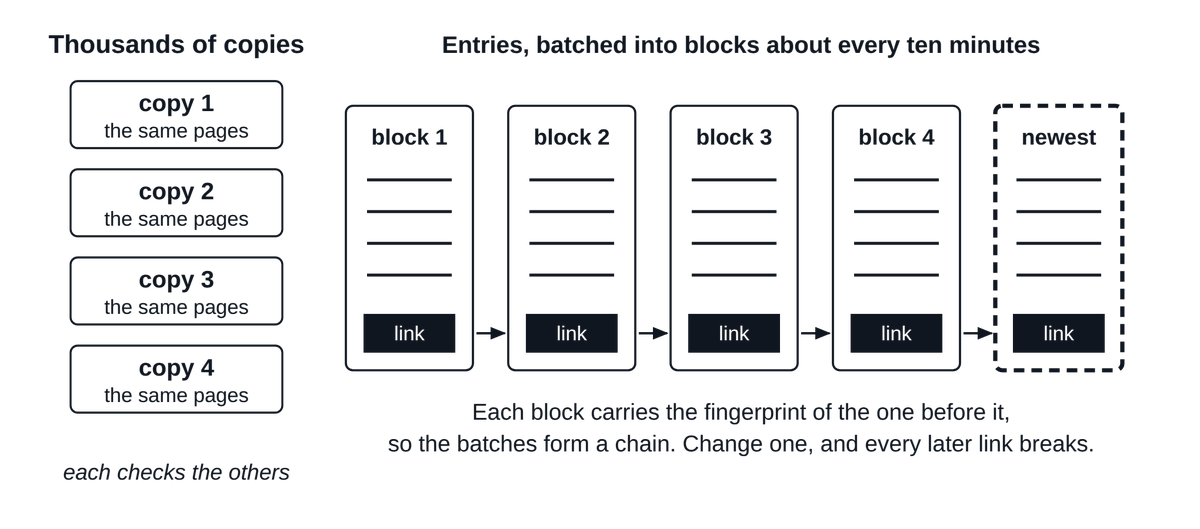
Bitcoin, right now
No price chart here on purpose. Chapter 6 covers price.
By the end of Chapter 4
Do it on your phone or laptop
- Audit one block. Fifteen minutes, phone or laptop. A block explorer is a website that shows you the ledger. Go to mempool.space.
- Open one of them. Note the highest block number on the page. That is the current block height. Note the time on the latest block.
- Open block 945,000 by typing the number into the search box. Find the transaction count, the size, and the first transaction in the block, which is the miner’s payment. Confirm the subsidy is 3.125 bitcoin and see how much came from fees.
- Pick any other transaction in the block and open it. You will see amounts, addresses, and a fee, and no names.
- Go back to the home page and wait for the next block to be mined. Within about 10 minutes, sometimes 2, sometimes 20, a new block will appear. You have just watched the clock tick (aka a new block being added to the blockchain.)
- Optional: search for a free SHA-256 hash generator online, such as the one at codebeautify.org, and type your name into the tool, then change one letter and watch the fingerprint change completely.
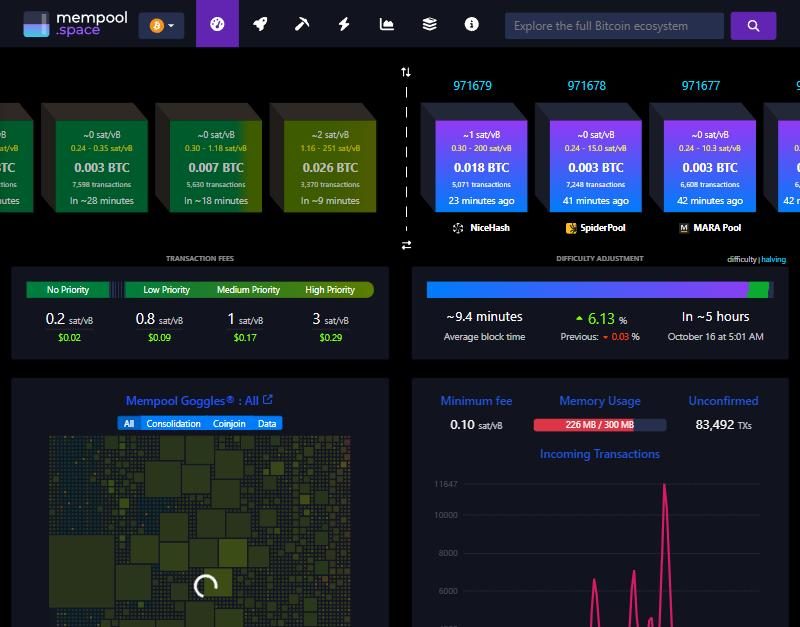
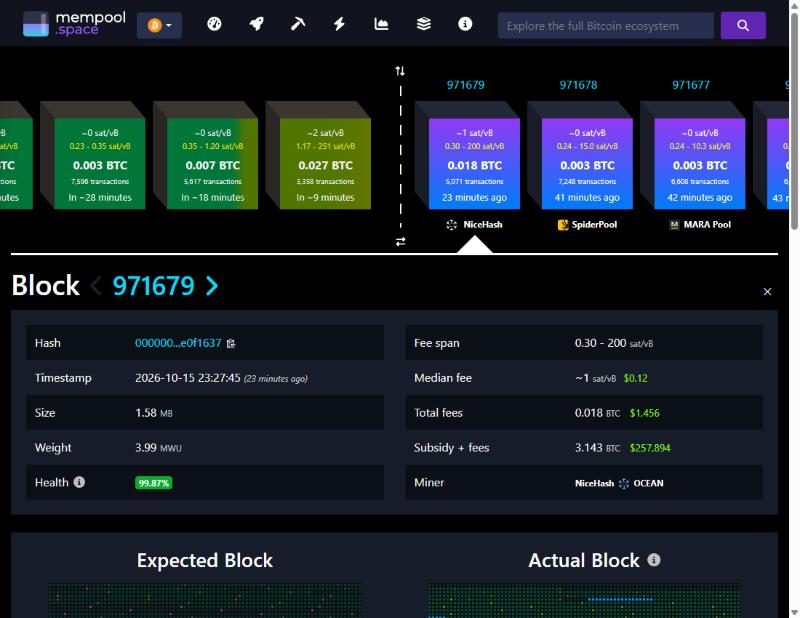
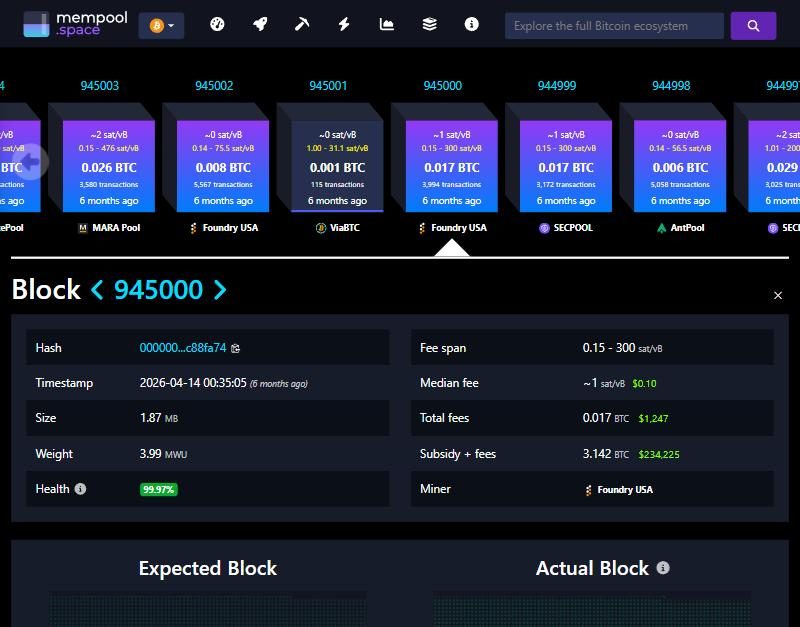
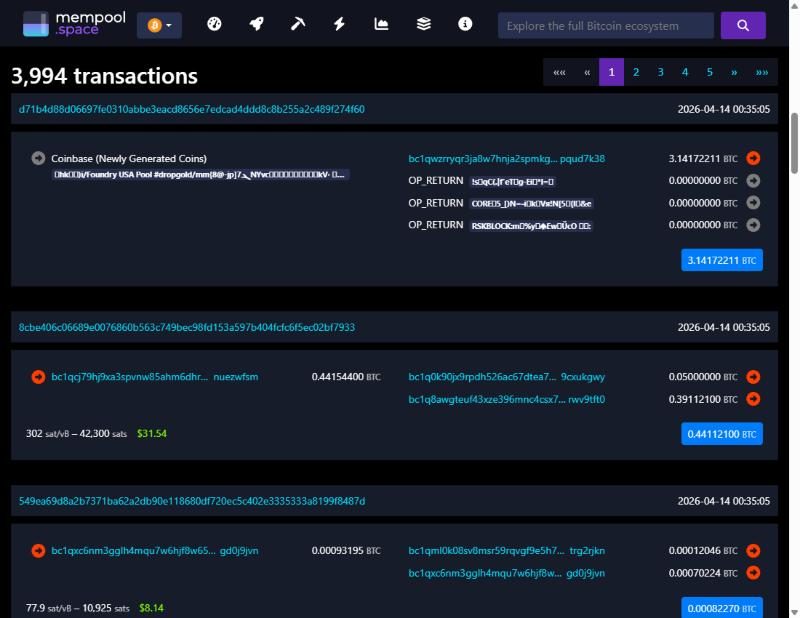
Screenshots of mempool.space, October 2026. The site changes its look from time to time; the labels keep their names. Step 5 is yours: go back to the home page and wait for the next block.
Did it stick?
Rate yourself: yes, mostly, or not yet. Not yet means reread that section. It does not mean you failed.
- I can explain the mailbox and the stamp to a friend, and say what a hash adds.
- I can say what a node does, what a miner does, and which one gets paid.
- I can explain why it costs more to cheat than it pays, without using the word “trust.”
- I can describe the halving schedule and say roughly what share of bitcoin has already been created.
- I can give both energy estimates, say which one is higher, and name a fair point on each side.
At a family dinner, your brother-in-law says, “Bitcoin is run by a handful of programmers and a few Chinese mining companies. They can change it whenever they want.” What do you say?
Say your answer out loud first. Then open the model response.
Show the model response
Programmers can propose changes, but no one has to install them. Every node checks every block against the rules it runs and rejects anything that breaks them, no matter who sent it. Miners only put transactions in order. They cannot create extra coins, spend anyone else’s bitcoin, or change the 21 million, because every node would throw the block out. And when China banned mining in 2021, about half the network went dark, the difficulty adjustment made the puzzle easier, and blocks kept coming about every 10 minutes.
The Part, in five sentences
- Since 1913 a committee decides how many dollars exist, and since 1971 nothing physical limits the number.
- New money reaches banks and asset owners first, and savers and wage earners last.
- Nodes check every rule, miners order the transactions, and proof of work makes rewriting the record too expensive to try.
- The difficulty adjustment keeps blocks about 10 minutes apart, and the halving cuts new supply every 210,000 blocks.
- Developers can propose changes, but nothing changes unless the people running nodes choose to run it.
“You say nobody is in charge, but I read that two mining pools account for more than half of all the blocks. Isn’t that a boss with a different name?”
My answer
The concentration is real. In the year to September 2026, the two largest pools, Foundry USA and AntPool, together found nearly half of all blocks. That deserves attention, and people in Bitcoin give it plenty.
Two facts limit what it means. A pool is not a miner. It is a coordinator that many independent miners point their machines at, and a miner can switch pools in an afternoon. When one pool briefly passed half the network in June 2014, miners left it, and its share fell to about a third within a month. And even a pool with a majority runs into that old laptop in Oklahoma City. It could delay transactions or reverse its own, at enormous cost. It could not create coins, spend yours, or change a rule, because the nodes would refuse the blocks.
So the objection is half right. Mining is more concentrated than the ideal, and if it got worse, the network would be weaker. But concentration doesn't put anyone in charge of the rules. That power sits with whoever checks, and there are roughly 26,000 of them.
Want a second opinion with sources? The Bitcoin Evidence Base answers claims like this one.
Watch, read, explore
But how does bitcoin actually work?
The same animated explainer as Chapter 1, now with the vocabulary to follow every step.3Blue1Brown on YouTubeExplore · 15 minAudit a block
Open block 945,000, then wait for a new one. The activity in Try it uses this site.mempool.spaceRead · BrowseLearn me a bitcoin
Plain technical guides with diagrams, for when you want one level deeper.learnmeabitcoin.comProducts and services named are examples, not recommendations. I have no financial relationship with any of them.
The 15 notes for Chapter 4
- Satoshi Nakamoto, “Bitcoin: A Peer-to-Peer Electronic Cash System,” bitcoin.org, 2008, sections 2, 3, 4 and 6. Schnorr signatures: BIP 340, activated November 2021.
- SHA-256 outputs for “Hello” and “hello,” reproducible with any standard SHA-256 tool.
- Reachable nodes: Bitnodes (btcnodes.io), reachable node snapshot of September 28, 2026 (25,799 nodes), retrieved September 2026; Coin Dance, coin.dance/nodes, retrieved September 2026 (25,620 nodes). Ledger size: Blockchain.com blockchain size chart, via YCharts, 771.7 gigabytes on September 28, 2026, retrieved September 2026.
- Network hash rate: Blockchain.com hash rate chart, via YCharts, 963.5 exahashes per second on September 27, 2026, with daily readings between about 800 and 1,045 exahashes per second in August and September 2026; CoinWarz Bitcoin hashrate chart, retrieved September 2026.
- Lucas Nuzzi, Kyle Waters and Matias Andrade, “Breaking BFT: Quantifying the Cost to Attack Bitcoin and Ethereum,” Coin Metrics, February 15, 2024 (SSRN 4727999): about 7 million ASIC machines, at a cost of more than $20 billion, as of early 2024.
- Block subsidy: Bitcoin Core source, GetBlockSubsidy in src/validation.cpp and nSubsidyHalvingInterval (210,000) in src/kernel/chainparams.cpp, github.com/bitcoin/bitcoin, retrieved September 2026. Daily block count: six blocks an hour times 24 hours; block 945,000 (note 8) shows the 3.125 subsidy in 2026.
- Bitcoin Gold, “Double Spend Attack on Exchanges,” forum.bitcoingold.org, May 2018 (attacks began May 18, 2018). Ethereum Classic: three attacks in August 2020, on August 1, in the first week of August, and on August 29; CoinDesk, “Ethereum Classic Hit by Third 51% Attack in a Month,” August 29, 2020, with the ETC Cooperative’s statement.
- Block 945,000: mempool.space/block/945000, retrieved September 2026. Mined April 14, 2026, 07:35 UTC; 3,994 transactions; 1.867 megabytes; Foundry USA; subsidy 3.125 bitcoin plus 0.01672 bitcoin in fees.
- Halving dates and heights: blocks 210,000 (November 28, 2012), 420,000 (July 9, 2016), 630,000 (May 11, 2020) and 840,000 (April 19, 2024, US time), from any block explorer; see also Blockstream Help Center, “What is the Bitcoin halving?”, retrieved September 2026. Share mined: the twenty-millionth bitcoin was created at block 939,999 on March 9, 2026 (The Block, March 9, 2026, citing on-chain data); by the subsidy schedule, about 20.09 million bitcoin, 95.7% of the cap, existed at block 969,000 in late September 2026.
- Contributor count: Bitcoin Core 30.0 release notes, bitcoin.org/en/releases/30.0, October 10, 2025, credit 197 contributors to that release. Funders: Brink, “Brink’s 2025 Annual Report,” brink.dev, May 26, 2026 (eight engineers funded in 2025); Spiral, Chaincode Labs, OpenSats and the Human Rights Foundation Bitcoin Development Fund, from each organization’s own site; 1A1z, “Funding Bitcoin,” October 23, 2024 (OpenSats and Spiral gave 62% of 2023 grant funding), as reported by Bitcoin Magazine, October 24, 2024.
- BIP 141 (Segregated Witness, 2017); BIP 341 (Taproot, 2021).
- Miner and company support: Digital Currency Group, “Bitcoin Scaling Agreement at Consensus 2017,” dcgco.medium.com, May 2017 (58 companies in 22 countries, 83.28% of hashing power). Suspension: Mike Belshe, Wences Casares, Jihan Wu, Jeff Garzik, Peter Smith and Erik Voorhees, “Segwit2x Final Steps,” email to the bitcoin-segwit2x mailing list, lists.linuxfoundation.org, November 8, 2017.
- Riot Platforms, “Riot Announces August 2023 Production and Operations Updates,” Form 8-K exhibit 99.1, sec.gov, September 6, 2023: $31.7 million in power and demand response credits for curtailing more than 95% of its load during ERCOT’s August 2023 heat wave. Conversion to AI hosting: CoinShares, “Bitcoin Mining Report Q2 2026,” coinshares.com, September 15, 2026 (IREN, TeraWulf, Cipher, Core Scientific and Keel; about $1.5 million a year per megawatt for AI hosting against about $0.5 million for mining). Larry Fink, Milken Institute Global Conference, May 2026 (see Chapter 4, note 33). IREN and Microsoft, about $9.7 billion over five years, and Cipher Mining and Amazon Web Services, about $5.5 billion over 15 years, both announced November 3, 2025: Decrypt, “Bitcoin Miners IREN, Cipher Rise After Multi-Billion-Dollar Microsoft, Amazon Deals,” November 3, 2025, decrypt.co, retrieved October 2026.
- Mining pool shares: mempool.space mining pool statistics, 1-year view, retrieved September 2026 (Foundry USA 28.3% and AntPool 18.0% of 52,225 blocks). GHash.io: CoinDesk, “The Bitcoin Mining Arms Race: GHash.io and the 51% Issue,” July 17, 2014 (about 55% of hash rate on June 12 and 13, 2014; 34.6% by July 13, 2014; pledge to stay below 40%).
- Cambridge Centre for Alternative Finance, mining map and hashrate data, 2021; the difficulty adjustment of July 3, 2021 lowered difficulty by about 28%, the largest downward adjustment on record, per public block data at mempool.space.
Found a broken link or a mistake? Write to [BOOK EMAIL] and I will fix it.