
Where money comes from
“There is no subtler, no surer means of overturning the existing basis of society than to debauch the currency.”John Maynard Keynes, The Economic Consequences of the Peace, 1919.This page in the book: yourbitcoinbasics.com/ch3
Bitcoin, right now
No price chart here on purpose. Chapter 6 covers price.
By the end of Chapter 3
Do it on your phone or laptop
- First, open the CPI Inflation Calculator on the Bureau of Labor Statistics website, bls.gov/data/inflation_calculator.htm. Enter $100 and the month and year of your first paycheck. Read what that $100 would need to be today to buy the same things. Then do it once more with August 1971.
- Second, read the Bitcoin genesis block yourself. Open the website mempool.space. In the search box, type the number 0. Scroll down to the bottom, and you will see the first transaction Satoshi made. Find the field labeled Coinbase and view it as text. The headline, Chancellor on brink of second bailout for banks, is checked against the ledger itself.
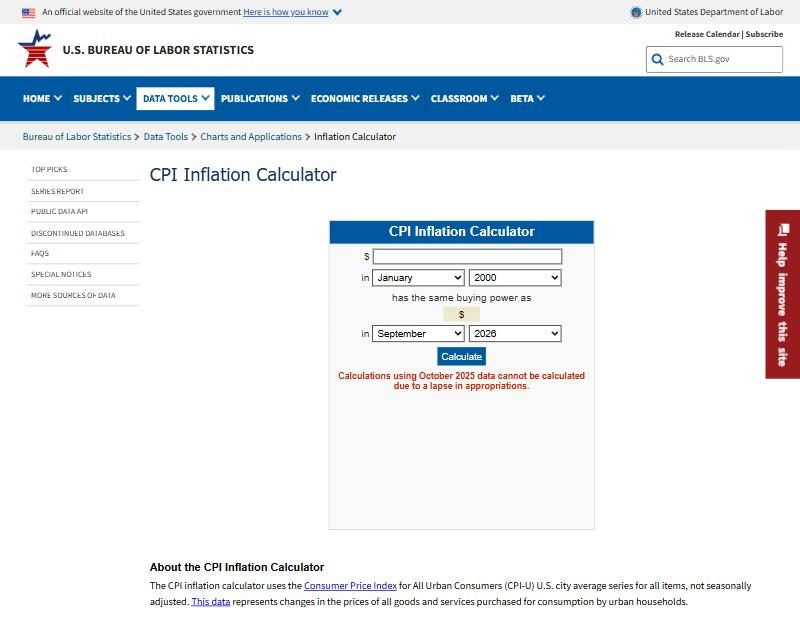
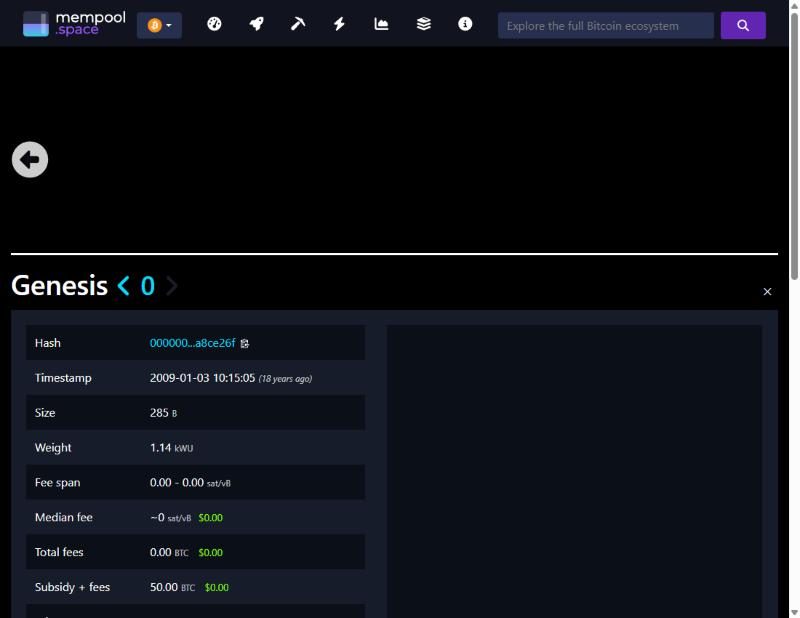
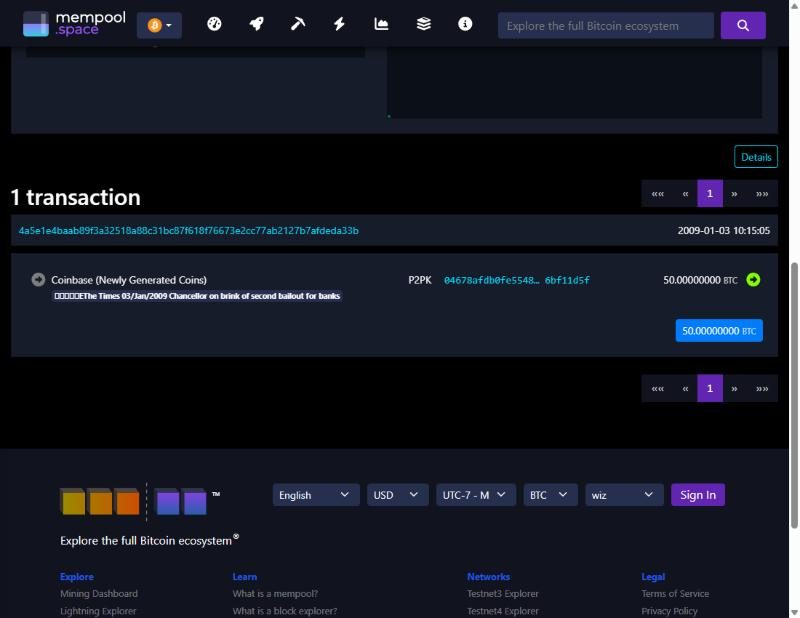
Screenshots of bls.gov and mempool.space, October 2026. Both sites change their look from time to time; the fields keep their names.
Did it stick?
Rate yourself: yes, mostly, or not yet. Not yet means reread that section. It does not mean you failed.
- I can say in one sentence each what changed in 1913, 1933 and 1971.
- I can explain why a bank’s records can show more dollars than were ever deposited.
- I can describe who receives new money first and who receives it last.
- I can explain why the Bitcoin whitepaper appeared in the fall of 2008.
At a family dinner, your uncle says, “Inflation is just greedy companies raising prices. It has nothing to do with the government.” What do you say?
Say your answer out loud first. Then open the model response.
Show the model response
Companies do raise prices, and shortages raise them too. But companies were greedy in 2015, and prices did not rise 9% in a year. What changed in 2020 and 2021 was the amount of money. M2 grew about 40% in two years, as the government sent checks and the Fed bought much of the borrowing that paid for them. Economists still argue about how much of the inflation came from the new money and how much from supply chains. Nobody argues that the money was new.
“Economists say a little inflation is healthy, and the Fed targets 2% on purpose. The gold standard had its own panics and depressions. Isn’t this chapter just nostalgia for a system that failed?”
My answer
The Fed does target 2%. The case for it is serious: a small, steady rise in prices leaves the Fed room to cut rates in a downturn, lets wages adjust without pay cuts, and keeps the economy a safe distance from falling prices. Falling prices, which the country suffered in the early 1930s, can be more destructive than rising ones, because debts stay fixed while incomes shrink. The gold era had panics of its own, and most historians judge that rigid gold rules made the Depression worse. This chapter has not argued for that.
Its claim is narrower. The 2% target is a choice made by a committee, and it compounds: at 2% a year, a dollar loses half its buying power in about 35 years. That loss falls hardest on people who hold cash or live on fixed incomes. It falls lightest on people who own assets, like stocks and homes, and on those closest to where new money enters: banks, large investors, and the government itself, which owes trillions of dollars and repays them in dollars’ worth less. Researchers who study who gets new money first find a clearer effect on asset prices than on wages. To be fair, the same low rates that lifted stocks after 2008 also brought unemployment down, which helped low-wage workers most. Whether that trade is worth it is a fair debate, and most people were never told the terms. A saver can beat the slow loss by moving cash into Treasury bills, I bonds, or other inflation-protected bonds, at the cost of paying attention. Treasury money market funds paid 4 to 5% from 2023 to 2025, more than inflation, and I bonds paid 9.62% for six months in 2022. The chapter’s point is about cash, and about who was ever told. Bitcoin’s answer is simple: money whose supply is set by a rule, not by a committee. Chapter 1 described that rule. Chapter 7 is plain about what Bitcoin gives up to keep it. You may read both and decide the trade is not worth it. That is allowed.
Want a second opinion with sources? The Bitcoin Evidence Base answers claims like this one.
Watch, read, explore
The IOU machine: how currency is created
Hidden Secrets of Money, episode 4. How a loan creates a deposit, with clear animation.YouTubeExplore · 10 minThe U.S. dollar system
A detailed map of how dollars move among the Fed, the Treasury, banks and you. Too big for the book, good on a large screen.River (a company that sells bitcoin)Explore · 5 minCPI inflation calculator
Type in a year and a dollar amount and see what it takes to buy the same things today.Bureau of Labor StatisticsRead · 10 minAbout the Fed
The Federal Reserve’s own description of who runs it and what it does.federalreserve.govExplore · BrowseWhat happened in 1971?
Dozens of charts that bend around 1971. Read them with the counterpoints in Chapter 3 in mind.wtfhappenedin1971.comProducts and services named are examples, not recommendations. I have no financial relationship with any of them.
The 37 notes for Chapter 3
- David Graeber, Debt: The First 5,000 Years, Melville House, 2011.
- St. Louis Fed, “Gresham’s Law,” glossary.
- Coinage Act of 1965.
- Federal Reserve History, “The Panic of 1907.”
- Federal Reserve History, “The Meeting at Jekyll Island”; G. Edward Griffin, The Creature from Jekyll Island, 1994 (a popular account).
- Federal Reserve History, “Federal Reserve Act Signed into Law.”
- Federal Reserve Act of 1913, Section 16.
- Executive Order 6102, April 5, 1933.
- Gold Reserve Act of 1934.
- Public Law 93-373, 1974.
- Federal Reserve History, “Creation of the Bretton Woods System.”
- Richard Nixon, address to the nation, August 15, 1971, American Presidency Project.
- BLS, CPI Inflation Calculator, and BLS, CPI-U All Items index (1982-84=100): January 1913, 9.8; August 1971, 40.8; August 2026, 334.980 (Consumer Price Index news release for August 2026). One January 1913 dollar equals about $34 in August 2026 dollars, one August 1971 dollar about $8.20. bls.gov, retrieved September 2026.
- U.S. Department of Labor, federal minimum wage history.
- McLeay, Radia and Thomas, “Money creation in the modern economy,” Bank of England Quarterly Bulletin, 2014 Q1.
- Standard textbook money-multiplier illustration; note 15 explains the simplification.
- Board of Governors, “Reserve Requirements,” March 26, 2020.
- Board of Governors of the Federal Reserve System, H.6 Money Stock Measures, via FRED series MBCURRCIR (currency in circulation, $2,475.6 billion) and M2SL (M2, $23,342.8 billion), both for August 2026, about 10.6%. fred.stlouisfed.org, retrieved September 2026. (The older FRED series CURRCIR is discontinued.)
- Board of Governors, H.4.1 Factors Affecting Reserve Balances, via FRED series WALCL: $905.3 billion on September 3, 2008; peak of $8,965.5 billion on April 13, 2022; $6,747.7 billion on September 23, 2026. fred.stlouisfed.org, retrieved September 2026.
- Board of Governors, H.6, via FRED series M2SL: $15,492.8 billion in February 2020, $21,725.6 billion in February 2022 (40.2% growth), $21,788.1 billion in March 2022 (40.6%). fred.stlouisfed.org, retrieved September 2026.
- BLS, CPI release for June 2022.
- Richard Cantillon, Essai sur la nature du commerce en général, 1755.
- U.S. Postal Service, “U.S. Postal Service Recommends New Prices for July,” news release, April 9, 2026; First-Class Mail Forever stamp raised from 78 to 82 cents effective July 12, 2026, as approved by the Postal Regulatory Commission. about.usps.com, retrieved September 2026.
- Federal Reserve History, “The Financial Crisis of 2008.”
- Federal Reserve History, “Support for Specific Institutions: AIG.”
- Emergency Economic Stabilization Act of 2008; U.S. Department of the Treasury, “About TARP,” Office of Financial Stability: $700 billion authorized, $443.5 billion disbursed. home.treasury.gov, retrieved September 2026.
- BLS, Employment Situation, October 2009.
- CoreLogic, “United States Residential Foreclosure Crisis: Ten Years Later,” March 2017: about 7.8 million completed foreclosures nationally from January 2007 through 2016, peaking at about 1.2 million in 2010.
- Satoshi Nakamoto, “Bitcoin: A Peer-to-Peer Electronic Cash System,” October 31, 2008.
- Bitcoin block 0, coinbase transaction; The Times (London), January 3, 2009.
- Ben S. Bernanke, Essays on the Great Depression, 2000; Barry Eichengreen, Golden Fetters, 1992.
- Jack Mallers, chief executive of Strike, speaking at Bitcoin Amsterdam, October 2025, as quoted by The Bitcoin Conference and Bitcoin Amsterdam on X; the line was already circulating under his name in December 2024. His own post on X, April 29, 2025; Times Square billboard, December 9, 2025, as posted by Bitcoin Magazine on X that day and reported by TechStory, “Times Square Goes Orange,” December 11, 2025. The first occasion he said the line is not documented.
- Economic Policy Institute, “The Productivity-Pay Gap,” updated 2025, epi.org: net productivity up about 80% from 1979 to 2024, hourly compensation of production and nonsupervisory workers up about 29%, both after inflation. For the smaller gap found with one deflator and total compensation, see Robert Z. Lawrence, “Does Productivity Still Determine Worker Compensation?,” Peterson Institute for International Economics, 2016. For the causes economists cite, see Josh Bivens and Lawrence Mishel, “Understanding the Historic Divergence Between Productivity and a Typical Worker’s Pay,” Economic Policy Institute, 2015. Larry Fink, in “A Conversation with BlackRock CEO Larry Fink and Brookfield Corporation CEO Bruce Flatt,” moderated by Michael Milken, Milken Institute Global Conference, Los Angeles, May 2026, video on the Milken Institute YouTube channel, retrieved October 2026.
- Board of Governors of the Federal Reserve System, “About the Fed” and “Federal Reserve Act” (Section 2A, monetary policy objectives; Section 10, 14-year terms for governors), federalreserve.gov; Trump v. Cook, U.S. Supreme Court, June 2026, as reported by Al Jazeera, June 29, 2026, and NPR (retrieved October 2026). Kevin Warsh succeeded Jerome Powell as chair on May 22, 2026.
- Federal Reserve Bank of Minneapolis, “Consumer Price Index, 1800–,” minneapolisfed.org (estimates before 1913): index of 51 in 1800, 36 in 1873, 25 in 1896 and 1900, and 29.7 in 1913 (1967 = 100), retrieved October 2026.
- U.S. Bureau of Labor Statistics, “Highlights of Women’s Earnings in 2024,” BLS Reports, bls.gov: women working full time earned 82.7% of men’s median weekly earnings in 2024, and 88.3% at ages 25 to 34 (retrieved October 2026).
- TreasuryDirect, “I bonds interest rates,” treasurydirect.gov: 9.62% annualized for I bonds issued May through October 2022; money market fund yields from the Investment Company Institute and Crane Data, 2023 to 2025 (retrieved October 2026).
Found a broken link or a mistake? Write to [BOOK EMAIL] and I will fix it.