How people find Bitcoin
“Running bitcoin”Hal Finney, the first person to receive a bitcoin transaction, on Twitter, January 11, 2009.This page in the book: yourbitcoinbasics.com/ch2
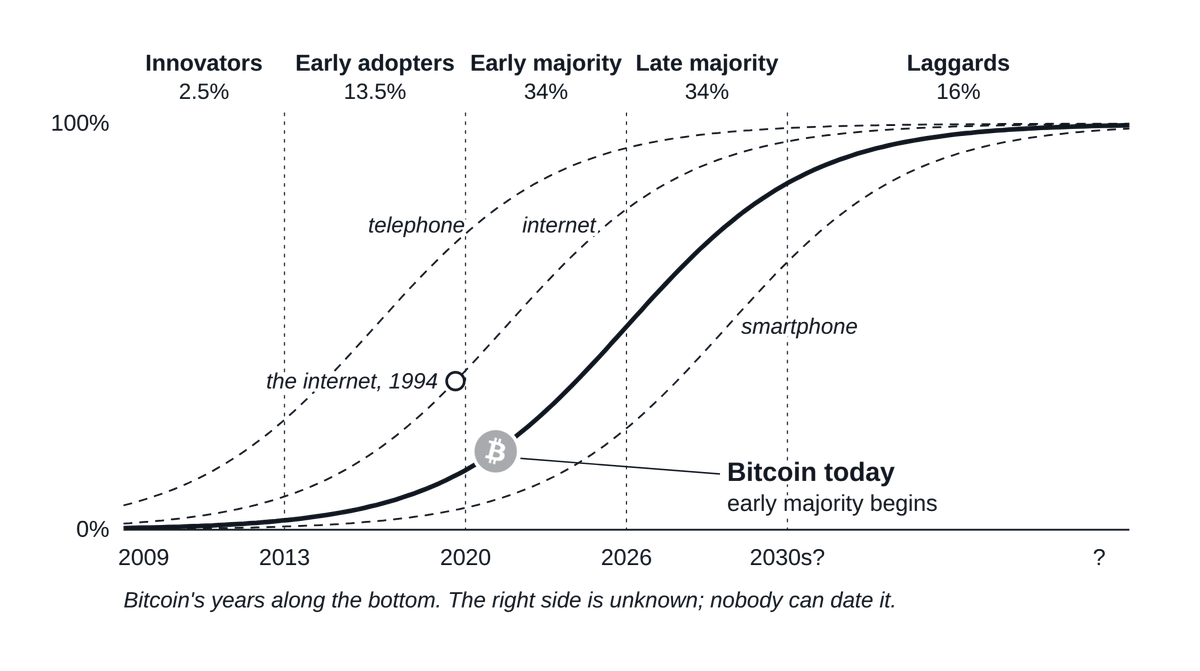
Bitcoin, right now
No price chart here on purpose. Chapter 6 covers price.
By the end of Chapter 2
Do it on your phone or laptop
- Decide for yourself, and research anything before you use it.
- Find your year. About 15 minutes on a phone or laptop.
- Go to yourbitcoinbasics.com/ch2. You will see the adoption curves for the telephone, the car, the television, the internet, and the smartphone laid over each other.
- For each one, type in the year you first used it. A guess within a few years is fine.
- Look at where you landed on each curve. Then look at where Bitcoin sits today.
For each one, type the year you first used it. A guess within a few years is fine. If you never have, leave it blank.
Where these numbers come from
- Telephone: share of U.S. households, 1905 to 2000. Comin and Hobijn (2004) and others, compiled by Our World in Data.
- Car: households with at least one vehicle. 1952: University of Michigan Survey of Consumer Finances (65%), as reported by Kopecky and Suen (2004). 1960: U.S. Census, via the Volpe Center’s Journey-to-Work Trends, 1960–1990 (78%). 1995: FHWA National Personal Transportation Survey (92% of families). 2020: Census American Community Survey (91.5%). Figures before 1952 are too patchy to plot.
- Television: U.S. Census Bureau history: 9% of households in 1950, 65% in 1955, 46 of 53 million housing units (87%) in 1960, 93% in 1965, 95.5% in 1970.
- Internet: 1995 and 1997 are households (Our World in Data compilation). 2000 to 2015 are U.S. adults: Pew Research Center, “Americans’ Internet Access: 2000–2015.”
- Smartphone: U.S. adults, Pew Research Center Mobile Fact Sheet, surveys from May 2011 (35%) to June 2025 (91%).
- Bitcoin: Gallup, June 2025, 14% of U.S. adults own bitcoin or another cryptocurrency; River, 2025, about 4% of the world’s population owns bitcoin.
- Points between surveys are joined with straight lines. Households and adults are different measures, so read the lines as a picture, not a precise comparison. Rogers’ groups: the first 2.5% are innovators, the next 13.5% early adopters, then 34% early majority, 34% late majority, and the last 16% laggards.
Did it stick?
Rate yourself: yes, mostly, or not yet. Not yet means reread that section. It does not mean you failed.
- I can explain the difference between “late” and “too late” to a friend.
- I can say roughly what share of the world owns bitcoin and where that puts it on the adoption curve.
- I can name two reasons other than price that people come to Bitcoin.
- I can describe my own starting point in one sentence.
Your neighbor says, “I looked at Bitcoin years ago and didn’t buy. Way too late now.” What do you say?
Say your answer out loud first. Then open the model response.
Show the model response
You were late. So was everyone who said that at $100, at $1,000, and at $20,000. Late means the price is higher than it was. Too late means no gain is left, and that call has been wrong at every price so far. That is history, not a promise about next year. About 4% of the world owns any bitcoin, so if you want to understand it, you are early for that. Whether to buy is a separate decision, and it starts with learning, not with the price you missed.
The Part, in five sentences
- Bitcoin is a shared record of who owns what, kept in identical copies on thousands of computers, with no company and no boss.
- There will only ever be 21 million bitcoin, and each one divides into 100 million sats, so nobody has to buy a whole one.
- A key, not an account, proves what you own, and whoever holds the key controls the bitcoin.
- Most people find bitcoin through another person, and the reason you came predicts what you will do when the price falls.
- “Too late” is a feeling, and being early to understand something is not the same as it being a good buy.
“Isn’t the adoption curve just a story people tell themselves so they feel smart for buying early?”
My answer
Partly, yes. The curve gets used as a sales pitch, and you should be suspicious whenever it is.
The curve does not tell you that Bitcoin will succeed. Plenty of technologies stalled at a few percent and died. What the curve tells you is only this: Bitcoin has been adopted by more people, more companies, and more governments every year for more than 17 years, through crashes that would have ended a fad. That is a statement about the past. This chapter’s only claim is that you are not too late to understand it.
Want a second opinion with sources? The Bitcoin Evidence Base answers claims like this one.
Watch, read, explore
Bitcoin Boomers podcast
Questions from people who came to Bitcoin later in life, answered without jargon.YouTubeWatch · 7 minWe are still so early
Terence Michael on where Bitcoin sits on the adoption curve. One of many short explainers on his page.terencemichael.comExplore · BrowseThe Bitcoin Evidence Base
Claims about Bitcoin, sorted by the research behind them.bitcoinevidencebase.comProducts and services named are examples, not recommendations. I have no financial relationship with any of them.
The 23 notes for Chapter 2
- Price milestones: about $100 in April 2013 and $1,000 on November 27, 2013 (CoinMarketCap Academy, “Bitcoin Price History and Events Timeline,” and davemanuel.com, “Bitcoin Price History,” retrieved September 2026); $5,000 in October 2017 and $10,000 in late November 2017 (same sources); $30,000 on January 2, 2021 (CNBC, January 2, 2021); $50,000 on February 12, 2024 (CNBC and CoinDesk, February 12, 2024).
- River Financial, Bitcoin Adoption Report 2025 (March 2025), which puts the share of the world’s population holding bitcoin at about 4% as of early 2025; river.com, retrieved September 2026.
- Everett M. Rogers, Diffusion of Innovations, Free Press, 1962.
- U.S. Securities and Exchange Commission, statement on approval of spot bitcoin exchange-traded products, January 10, 2024.
- Executive Order 14233, “Establishment of the Strategic Bitcoin Reserve and United States Digital Asset Stockpile,” March 6, 2025, Federal Register, March 11, 2025. As of September 2026 the order remained in effect, the reserve held roughly 198,000 bitcoin, all from federal forfeitures, and a bill to write the reserve into law (H.R. 8957) was pending in the House (24/7 Wall St. via Yahoo Finance, September 15, 2026; retrieved September 2026).
- International Telecommunication Union, world internet users as a share of population, as compiled by Internet World Stats (1995: 0.4%; 1999: 4.1%) and Areppim (1995: 0.7%; 1999: 4.6%); retrieved September 2026.
- Mackinac Center for Public Policy, “The Overton Window.”
- Nicholas Klein, address to the Amalgamated Clothing Workers of America convention, Baltimore, 1918, proceedings. Commonly misattributed to Gandhi.
- Warren Buffett, Berkshire Hathaway annual meeting, May 2018, as reported by CNBC.
- Gallup, “Cryptocurrency Still Has Limited Main Street Appeal,” survey of June 2 to 15, 2025: 14% of U.S. adults own bitcoin or other cryptocurrency; 8% of women aged 18 to 49 and 9% of women 50 and older, against 25% of men aged 18 to 49 and 12% of men 50 and older; news.gallup.com, retrieved September 2026.
- FDIC, 2023 National Survey of Unbanked and Underbanked Households, published November 2024: 4.2% of households (5.6 million) unbanked and 14.2% (about 19 million) underbanked; fdic.gov, retrieved September 2026. The 2023 survey was the latest published as of September 2026.
- Bob Metcalfe, “From the Ether: Predicting the Internet’s catastrophic collapse and ghost sites galore in 1996,” InfoWorld, December 4, 1995; blender episode, Sixth International World Wide Web Conference, Santa Clara, April 1997, per Wired; column date and wording per Quote Investigator, “I Predict the Internet Will Soon Go Spectacularly Supernova” (March 2020), retrieved September 2026.
- Markku Kaustia and Samuli Knüpfer, “Peer Performance and Stock Market Entry,” Journal of Financial Economics 104, no. 2 (2012): 321-338; Harrison Hong, Jeffrey Kubik and Jeremy Stein, “Social Interaction and Stock-Market Participation,” Journal of Finance 59, no. 1 (2004).
- Robert Cialdini, Influence: The Psychology of Persuasion, new and expanded edition, Harper Business, 2021, chapter on social proof.
- Daniel Kahneman and Amos Tversky, “Prospect Theory: An Analysis of Decision under Risk,” Econometrica 47, no. 2 (1979).
- Amos Tversky and Daniel Kahneman, “Judgment under Uncertainty: Heuristics and Biases,” Science 185 (1974), on availability and anchoring.
- Jamie Dimon, remarks at the CNBC Delivering Alpha conference, New York, September 12, 2017 (bitcoin “a fraud” and “worse than tulip bulbs”), as reported by CNBC.
- Paul Krugman, “Bubble, Bubble, Fraud and Trouble,” The New York Times, January 29, 2018.
- Jamie Dimon, interview on CNBC’s Squawk Box from the World Economic Forum, Davos, January 19, 2023 (“Bitcoin itself is a hyped-up fraud. It’s a pet rock.”).
- Michael Saylor, interview with Raoul Pal, Real Vision, December 2020 (“melting ice cube”), and MicroStrategy press release, August 11, 2020, announcing the first $250 million bitcoin purchase.
- Orit Tykocinski and Thane Pittman, “The Consequences of Doing Nothing: Inaction Inertia as Avoidance of Anticipated Counterfactual Regret,” Journal of Personality and Social Psychology 75, no. 3 (1998); on anchoring, Tversky and Kahneman, 1974, cited above.
- Rachel Croson and Uri Gneezy, “Gender Differences in Preferences,” Journal of Economic Literature 47, no. 2 (2009): 448–474, a review of experiments finding that women on average choose less financial risk than men, with wide overlap between individuals.
- Bankrate, “Financial Infidelity Survey 2025,” bankrate.com, YouGov online survey of 2,217 U.S. adults, December 9–11, 2024; 40% of the 1,089 respondents who were married or living with a partner had kept a financial secret from that partner (retrieved October 2026).
Found a broken link or a mistake? Write to [BOOK EMAIL] and I will fix it.