When money fails people
“Whenever destroyers appear among men, they start by destroying money, for money is men’s protection and the base of a moral existence.”Ayn Rand, Atlas Shrugged, 1957.This page in the book: yourbitcoinbasics.com/ch5
Bitcoin, right now
No price chart here on purpose. Chapter 6 covers price.
By the end of Chapter 5
Do it on your phone or laptop
- Read the fine print you already agreed to. Fifteen minutes, on a phone or laptop.
- First, five minutes. Search for the Atlantic Council’s CBDC tracker (atlanticcouncil.org) and find the United States on the map, then one country from this chapter. Note the status of each.
- Then, 10 minutes. In a search engine, search for your bank's name with the words “deposit account agreement.” Open the document and use the search function to find “close,” “hold,” and “at any time.” Read the sentences around them. Most agreements say the bank may close your account at any time, for any reason or none, and may hold funds it considers suspicious. You signed this. Write down the two sentences that surprised you most.
Open your own bank’s deposit account agreement (search the bank’s name with “deposit account agreement”). Use the find function for each word below, read the sentences around it, and compare with what the clause usually says. If yours is gentler, good. Most are not.
Closing your account search for “close”
What it usually says. “We may close your account at any time, for any reason or no reason, with or without notice.” Most agreements say some version of this.
What it means for you. The bank decides whether you stay a customer. You are usually mailed a check for the balance, after a delay.
Holds on your money search for “hold”
What it usually says. “We may place a hold on funds” for deposits, suspected fraud, a legal order, or an investigation. Holds on large deposits of several days are routine; holds for investigations have no fixed end date.
What it means for you. A balance on your screen is not the same as money you can move today.
Changing the rules search for “at any time”
What it usually says. “We may change this agreement at any time.” Notice is often a line in a statement or an email you did not open.
What it means for you. The terms you agreed to are not the terms you will have. Reading the agreement once is not enough; the bank can rewrite it.
Right of setoff search for “setoff”
What it usually says. If you owe the bank money, on a card or a loan, it “may take funds from any account you have with us” to pay it, usually without asking first.
What it means for you. Your checking account is also the bank’s collateral.
Freezing for suspicion or legal process search for “freeze”
What it usually says. Accounts can be frozen on a court order, a garnishment, or the bank’s own suspicion of fraud, often with no reason given, because telling you may be against the law.
What it means for you. Chapter 5’s Canadian trucker story is this clause used at scale: one list, one week.
Arbitration and no class actions search for “arbitration”
What it usually says. Disputes go to a private arbitrator, not a court, and you agree not to join a class action.
What it means for you. If something goes wrong, you go alone, in a forum the bank chose.
What a deposit is search for “deposit”
What it usually says. The agreement rarely says it plainly, but in law a deposit is a loan from you to the bank. The bank owes you the money; it does not hold your money in a box.
What it means for you. That is why the FDIC exists, and why insurance has a limit. Chapter 5 covers what the limit meant in 2023.
This is a reading guide, not legal advice. Agreements differ by bank and change over time. A lawyer can tell you what yours means in your state.
Did it stick?
Rate yourself: yes, mostly, or not yet. Not yet means reread that section. It does not mean you failed.
- I can tell the story of two of the six people in this chapter and say what happened to their money.
- I can name the one thing all six cases had in common.
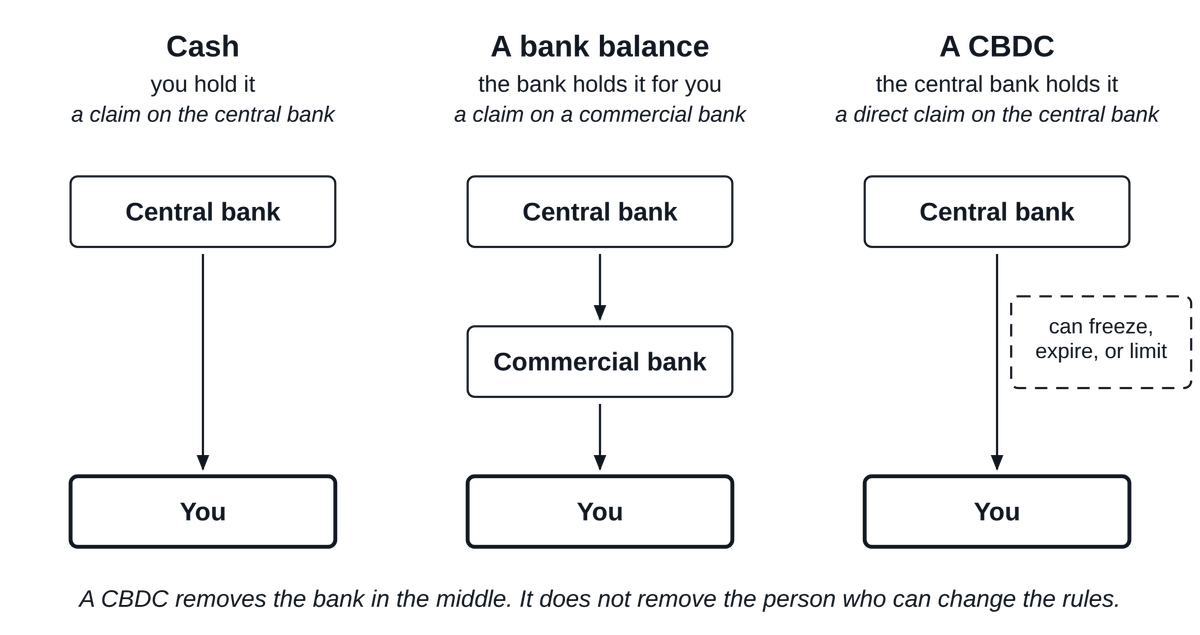
- I can explain what a CBDC is and give one reason it does not fix the problem in this chapter.
- I can state, in a sentence, what Bitcoin offers the refugee at the border, and what it does not.
- I can find the sentence in my own bank’s deposit agreement that says the bank may close my account.
Your brother-in-law says, “Cyprus, Lebanon, whatever. That is what happens in countries with bad governments. My money is in a bank in Ohio with a sticker on the door.” What do you say?
Say your answer out loud first. Then open the model response.
Show the model response
Ohio is not Beirut, and the sticker is real. No one has lost an insured dollar in a U.S. bank failure since 1934. Two things still apply at home. Your deposit is legally a loan to the bank, and your account agreement says the bank can freeze or close it, often without giving a reason. And the slow version runs everywhere: a dollar saved in 1971 buys about 12 cents’ worth today. Canada, a wealthy democracy with independent courts, froze accounts with one list in 2022.
“Every case in this chapter is another country or an emergency. I live in the United States, my deposits are insured, and there are courts. Isn’t this fear dressed up as history?”
My answer
Part of that is right. Since 1934, no depositor has lost a cent of insured money in an American bank failure, including in 2023, when regulators went beyond the insurance limit to cover everyone at two failed banks. At the larger of the two, Silicon Valley Bank, the trouble was an old one: deposits that could leave overnight had been put into long-term bonds that lost value when interest rates rose.
Three things stay true after you grant all that. The slow version is in the price index. Canada is a wealthy country with independent courts, and its freeze took one week and one list. And the deposit agreement you just read says what it says.
I am not asking you to be afraid. Fear is a poor reason to do anything with money, and it is the first tool every scam in Chapter 11 reaches for. I am asking you to notice one small thing. Until 2009, the question “who can stop me from using my own money?” had the same answer everywhere: someone. Now there is a form of money where the answer is different.
Want a second opinion with sources? The Bitcoin Evidence Base answers claims like this one.
Watch, read, explore
Bitcoin Beach
A documentary about a beach town in El Salvador that ran on bitcoin before the country did.YouTubeExplore · 5 minCentral bank digital currency tracker
Find the United States, then one country from this chapter, and note the status of each.Atlantic CouncilProducts and services named are examples, not recommendations. I have no financial relationship with any of them.
The 30 notes for Chapter 5
- Argentine Decree 1570/2001, December 1, 2001 (250 pesos a week); Decree 214/2002, February 3, 2002 (dollar deposits converted at 1.4 pesos per dollar); International Monetary Fund, “Lessons from the Crisis in Argentina,” 2003; American Enterprise Institute, “Resolution of Argentina’s Financial Crisis,” retrieved September 2026.
- INDEC, consumer price index, December 2023 release, January 11, 2024: 211.4% for calendar 2023.
- Chainalysis, “The 2025 Global Crypto Adoption Index,” chainalysis.com, September 2, 2025 (Argentina ranked 20th), retrieved September 2026.
- Banco Central de Venezuela, inflation and GDP statistics released May 28, 2019: 130,060% for 2018.
- Eurogroup statements, March 16 and 25, 2013; Bank of Cyprus, completion of recapitalisation, July 30, 2013 (47.5% of uninsured deposits converted to equity); Schaefer-Brown, “Cyprus: Laiki Bank and Bank of Cyprus Restructuring, 2013,” Journal of Financial Crises, Yale, 2024; European Stability Mechanism, “Crisis in Cyprus,” esm.europa.eu (all external capital controls lifted April 6, 2015), retrieved September 2026.
- European Union, Bank Recovery and Resolution Directive (2014/59/EU), 2014.
- StatMuse Money, bitcoin daily closes, March 1, 2013 ($34.06), retrieved September 2026; Cointelegraph, “Will Grexit Force Bitcoin Price to Spike like the 2013 Cyprus Collapse,” 2015 (bitcoin in the $230 range on April 9, 2013); Bitcoin Magazine, “The Bitcoin Crash: An Examination,” April 14, 2013; StatMuse Money, daily closes, April 9 to 11, 2013 ($189.91, $228.20 and $151.04), retrieved October 2026.
- The National, “Lebanese banks to reopen as withdrawal limits made official,” November 2019; Al Jazeera, “‘Not legal’ but necessary: Lebanon’s banks tighten restrictions,” February 3, 2020; Organized Crime and Corruption Reporting Project, “Lebanon Central Bank Governor’s Son Moved Millions Abroad While Lebanese Watched Blocked Savings Dwindle,” May 13, 2022 (estimate of up to $6 billion moved abroad), retrieved September 2026.
- World Bank, Lebanon Economic Monitor, Spring 2021, “Lebanon Sinking (to the Top 3),” press release June 1, 2021; World Bank, “Lebanon: Normalization of Crisis is No Road to Stabilization,” press release May 16, 2023 (lira lost more than 98% of its pre-crisis value by February 2023).
- Associated Press, via CBS News, “Woman with toy gun breaks into Beirut bank to take $13,000 in locked savings,” September 14, 2022; Washington Post, “Armed woman stages heist at Blom Bank in Beirut to recover savings,” September 14, 2022.
- National Bank of Ukraine, Resolution No. 18, “On the Operation of the Banking System under Martial Law,” February 24, 2022, bank.gov.ua, retrieved September 2026.
- CNBC, “Ukrainian refugee flees to Poland with $2,000 in bitcoin on a USB drive,” March 23, 2022.
- CoinDesk, “Ukraine Has Received Close to $100M in Crypto Donations,” March 9, 2022, citing Deputy Minister of Digital Transformation Alex Bornyakov; Elliptic, “Crypto donations to Ukraine and Russia: breaking down the numbers,” May 9, 2023 (about $30 million in the first four days).
- Government of Canada, Emergency Economic Measures Order, SOR/2022-22, February 15, 2022; testimony of Isabelle Jacques, Assistant Deputy Minister, Department of Finance, to the House of Commons Standing Committee on Finance, February 22, 2022 (about 210 accounts, about $7.8 million), as reported by CBC News, February 22, 2022; Department of Finance Canada, remarks by the Deputy Prime Minister and Minister of Finance, June 14, 2022 (about 280 financial products, about 8 million Canadian dollars, the final count).
- Globe and Mail, “RCMP, banks and Ottawa say convoy protest donors won’t have accounts frozen,” February 2022 (claim by MP Mark Strahl; RCMP said no donor list was given to banks).
- Public Order Emergency Commission, Final Report, February 17, 2023; Canadian Frontline Nurses v. Canada (Attorney General), 2024 FC 42, January 23, 2024; Canada (Attorney General) v. Canadian Frontline Nurses, 2026 FCA 6, January 16, 2026; CTV News and CP24, “Federal government appeals to Supreme Court on ruling over use of Emergencies Act,” March 17, 2026. Status as of September 2026: leave to appeal sought, not yet decided.
- CoinDesk, “‘Frozen’ Bitcoin Tied to Canadian Protests Lands at Coinbase, Crypto.com,” February 22, 2022 (about 20 BTC raised; 14.6 BTC distributed); Vice, “The ‘Freedom Convoy’ Bitcoin Donations Have Been Frozen and Seized,” March 15, 2022 (Ontario Superior Court Mareva order, February 17, 2022); Bitcoin Magazine, “Honk, Honk, HODL,” June 30, 2022.
- Consumer Financial Protection Bureau, “CFPB Takes Steps to Improve Checking Account Access,” press release, February 3, 2016; CFPB, “Helping consumers who have been denied checking accounts,” February 2016.
- Bryan and Collins, “Locked out of banking: The limits of financial inclusion for formerly incarcerated individuals,” Social Science Research, vol. 122, 2024.
- FDIC, 2023 National Survey of Unbanked and Underbanked Households, released November 12, 2024 (4.2% unbanked, 5.6 million households; 14.2% underbanked, 19.0 million households); the most recent survey published as of September 2026.
- U.S. Bureau of Labor Statistics, CPI-U, all items, 1982-84=100: 1971 annual average 40.5; 2025 annual average 322.2 (a 1971 dollar equals about 12.6 cents as of 2025); December 2020 to December 2023, 12-month changes of 7.0, 6.5 and 3.4%, compounding to about 18%. BLS, “Consumer Price Index: 2023 in review,” January 2024, retrieved September 2026.
- White House, Executive Order 14331, “Guaranteeing Fair Banking for All Americans,” August 7, 2025, 90 Fed. Reg. (August 12, 2025).
- Foley v. Hill (1848) 2 HLC 28, House of Lords.
- Atlantic Council, Central Bank Digital Currency Tracker, atlanticcouncil.org, updated May 2026 (146 countries and currency unions; three launched), retrieved September 2026; White House, Executive Order 14178, “Strengthening American Leadership in Digital Financial Technology,” January 23, 2025, section 5(a); Board of Governors of the Federal Reserve System, “Central Bank Digital Currency (CBDC) FAQs,” federalreserve.gov (the Fed would only proceed with a CBDC with authorizing legislation), retrieved September 2026.
- South China Morning Post, “China’s Shenzhen giving away millions in sovereign digital yuan,” October 2020 (200-yuan packets spendable October 12 to 18); The Paypers, “China tests its CBDC in Shenzhen,” October 20, 2020 (unused amounts to be taken back).
- Ree, “Nigeria’s eNaira, One Year After,” IMF Working Paper WP/23/104, May 16, 2023; Central Bank of Nigeria, circular lifting the restriction on banks serving virtual asset service providers, December 22, 2023.
- Iowa Attorney General, “Attorney General Bird Sues Crypto ATM Companies for Costing Iowans More Than $20 Million,” February 26, 2025 (Bitcoin Depot 23%, CoinFlip 21%); CNN, investigation of crypto ATM markups, October 14, 2025.
- World Bank, Remittance Prices Worldwide, Issue 54, third quarter 2025 (global average 6.36% for $200), remittanceprices.worldbank.org, retrieved September 2026; UN Sustainable Development Goal target 10.c.
- FDIC, “Understanding Deposit Insurance,” fdic.gov (no depositor has lost a penny of insured funds since the FDIC’s founding; insurance took effect January 1, 1934), retrieved September 2026; Joint statement by the Treasury, Federal Reserve and FDIC on the systemic risk exception for Silicon Valley Bank and Signature Bank, March 12, 2023. Silicon Valley Bank: Board of Governors of the Federal Reserve System, “Review of the Federal Reserve’s Supervision and Regulation of Silicon Valley Bank,” April 28, 2023, federalreserve.gov.
- World Bank, Global Findex Database 2021: women are more likely than men to lack an account worldwide, and the gap is widest in low-income economies; International Organization for Migration, World Migration Report 2024, on women as the majority of remittance recipients.
Found a broken link or a mistake? Write to ybbook@proton.me and I will fix it.