
Bitcoin and meaning
“If a thousand men were not to pay their tax bills this year, that would not be a violent and bloody measure, as it would be to pay them, and enable the State to commit violence and shed innocent blood. This is, in fact, the definition of a peaceable revolution, if any such is possible.”Henry David Thoreau, Civil Disobedience, 1849.This page in the book: yourbitcoinbasics.com/ch14
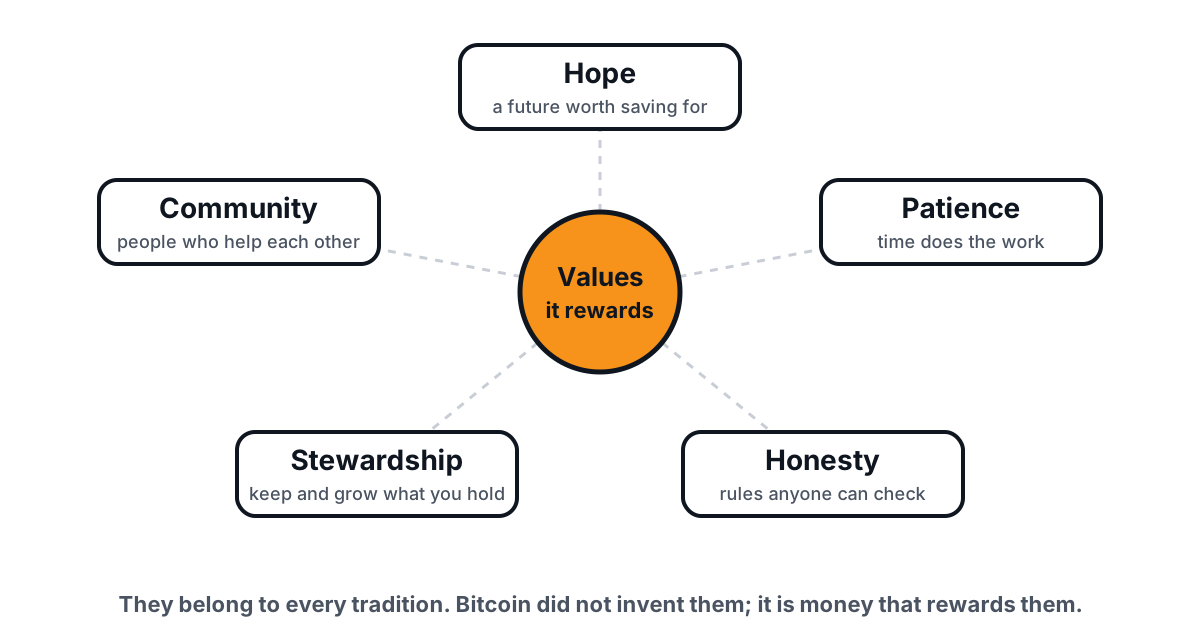
Bitcoin, right now
No price chart here on purpose. Chapter 6 covers price.
By the end of Chapter 14
Do it on your phone or laptop
- Check the promise yourself. About 15 minutes, on a phone or laptop, nothing to buy.
- Open a block explorer, which is a website that shows the ledger live. Two examples: mempool.space (named for the mempool, where transactions wait; see Chapter 4) and blockstream.info. Find the current block height, the number of the latest block.
- Multiply that number by 10 minutes. Divide by 525,600, the minutes in a year. That is how many years of blocks the network has produced if every block took exactly 10 minutes.
- Now count the years from January 3, 2009, to today.
- Compare. The two numbers will be close, and the block count will run a little ahead, because as mining power grows, the difficulty adjustment from Chapter 4 can take up to two weeks to catch up. Write down the gap.
- Then write the answer to one question: what else in your financial life could you check this way?
Loading the block height…
One block about every 10 minutes since January 3, 2009. The block count runs a little ahead because the difficulty adjustment chases a growing network.
Did it stick?
Rate yourself: yes, mostly, or not yet. Not yet means reread that section. It does not mean you failed.
- I can explain why patience has more to do with trust than willpower, and name the research behind that.
- I can say what “low time preference” means and give one example from my own life outside money.
- I can name two things that change when money cannot be debased or frozen, and two things that do not.
- I can say what “fix the money, fix the world” can plausibly deliver and name two things it cannot.
- I can describe a Bitcoin standard as a mindset and name one practice with its trade-off.
A friend says, “Bitcoin people talk about it like it is a church. It is a speculative asset, and the values talk is a sales pitch.” What do you say?
Say your answer out loud first. Then open the model response.
Show the model response
Some of it is a pitch, and you should be suspicious whenever someone sells values along with an asset. But part of it you can check yourself. Bitcoin promised a block about every 10 minutes and a supply that never passes 21 million. Count the blocks since January 2009 and the math matches. Very little else in a person’s financial life lets you check the promise instead of trusting it. People who hold for years talk about patience because the system rewards waiting. That is a description, not a creed.
“Isn’t attaching virtues to an asset just religion with a ticker symbol? People who own gold say the same things about themselves.”
My answer
Partly, yes, and you should hold onto that suspicion. Gold owners have talked about discipline and stewardship for centuries, and some of it was self-congratulation. So is some of what you will hear from Bitcoin people. Owning an asset does not make anyone virtuous, and plenty of people who hold bitcoin gamble it, brag about it, or use it to lie to the people who trust them.
Here is the version of the claim I can stand behind. The values in this chapter are older than money. What trustworthy money does is stop punishing them. A person who wants to be patient in a currency that loses a third of its value in a decade is fighting the current. In a money with a fixed supply, the current runs the other way. That is a condition, and the virtue is still up to the person. In 25 years of classrooms, I've seen that conditions matter more than lectures, which is why this book teaches by doing rather than preaching. Take the values, test the money, and keep your suspicion.
Want a second opinion with sources? The Bitcoin Evidence Base answers claims like this one.
Watch, read, explore
What is money?
Long conversations about money, time and meaning. Start with one episode.Robert Breedlove on YouTubeExplore · 15 minCheck the promise
Look up the current block height for the Try it activity.mempool.spaceProducts and services named are examples, not recommendations. I have no financial relationship with any of them.
The 23 notes for Chapter 14
- U.S. Bureau of Labor Statistics, Consumer Price Index for All Urban Consumers (CPI-U, series CUUR0000SA0), December 2020 to December 2025, a rise of 24.4%; the 2020 to 2025 annual averages give the same 24.4%. Series retrieved through FRED, Federal Reserve Bank of St. Louis, September 2026.
- Satoshi Nakamoto, “Bitcoin: A Peer-to-Peer Electronic Cash System,” section 6, 2008.
- W. Mischel, E. B. Ebbesen and A. R. Zeiss, “Cognitive and Attentional Mechanisms in Delay of Gratification,” Journal of Personality and Social Psychology 21, no. 2 (1972): 204 to 218.
- C. Kidd, H. Palmeri and R. N. Aslin, “Rational Snacking: Young Children’s Decision-Making on the Marshmallow Task Is Moderated by Beliefs About Environmental Reliability,” Cognition 126, no. 1 (2013): 109 to 114. Children in the reliable condition waited a mean of 12 minutes 2 seconds; children in the unreliable condition waited a mean of 3 minutes 2 seconds.
- T. W. Watts, G. J. Duncan and H. Quan, “Revisiting the Marshmallow Test: A Conceptual Replication Investigating Links Between Early Delay of Gratification and Later Outcomes,” Psychological Science 29, no. 7 (2018): 1159 to 1177. The correlation between delay at age 4 and achievement at age 15 fell by about two thirds once family background, early cognitive ability and home environment were controlled for.
- Jeff Booth, author of The Price of Tomorrow (Stanley Press, 2020). Quotation: Christina Comben, “Jeff Booth wants you to move more of your time into Bitcoin,” CryptoSlate, October 26, 2025, cryptoslate.com, retrieved October 2026. A longer wording shown in the author’s UNLV OLLI course materials in May 2026 could not be traced to a source, so the text paraphrases it.
- Federal Reserve Bank of St. Louis, FRED, series M2SL (M2 money stock, seasonally adjusted): $15,425.0 billion in January 2020 and $21,647.4 billion in January 2022, a rise of 40.3%. Retrieved September 2026.
- Department of Finance Canada, “Remarks by the Deputy Prime Minister and Minister of Finance,” June 14, 2022, canada.ca, retrieved September 2026: approximately 280 financial products, including savings and checking accounts, credit cards and lines of credit, totaling approximately 8 million Canadian dollars, were frozen as of February 21, 2022. See also Public Order Emergency Commission, Report of the Public Inquiry into the 2022 Public Order Emergency, Government of Canada, February 2023.
- U.S. International Trade Administration, “Lebanon Country Commercial Guide: Trade Financing,” trade.gov, updated February 2026, retrieved September 2026 (banks introduced informal capital controls in late 2019 and have accumulated more than $72 billion in losses); The National, “Lebanon’s bank customers won’t see the $93 billion they are owed any time soon,” April 16, 2025; UPI, “Seven years after crisis, Lebanon’s banks struggle to survive,” September 8, 2026.
- FBI Internet Crime Complaint Center, 2024 Internet Crime Report, April 2025, ic3.gov, retrieved September 2026: 149,686 cryptocurrency-related complaints and $9.3 billion in losses for 2024. The 2025 Internet Crime Report, released April 2026, put 2025 losses above $11 billion.
- On the suspension of the gold standard at the outbreak of the First World War: Barry Eichengreen, Golden Fetters: The Gold Standard and the Great Depression, 1919 to 1939, Oxford University Press, 1992.
- Daniel Krawisz, “Hyperbitcoinization,” Satoshi Nakamoto Institute, March 29, 2014.
- Spot bitcoin exchange-traded funds approved by the SEC, January 2024; Executive Order 14233, “Establishment of the Strategic Bitcoin Reserve and United States Digital Asset Stockpile,” signed March 6, 2025, 90 Fed. Reg. 11789 (March 11, 2025), federalregister.gov, retrieved September 2026. The order capitalizes the reserve with bitcoin already forfeited to the government and permits only budget-neutral acquisitions. As of September 2026 the government had made no purchases and had not published an official count of its holdings (CoinDesk, “U.S. Bitcoin Reserve update coming in ‘next few weeks,’ White House advisor says,” May 6, 2026).
- Saifedean Ammous, The Bitcoin Standard, Wiley, 2018.
- CNBC, “This family bet it all on bitcoin,” October 17, 2017 (the Dutch Taihuttu family sold their house, cars and possessions in 2017); Decrypt, “The Bitcoin Family: Still on the Road After Three Years,” 2020; CNBC, June 7, 2025, on the family’s continued travels. Retrieved September 2026.
- CBS News, 60 Minutes, “Bitcoin Beach: How a town in El Salvador became a testing ground for bitcoin,” April 10, 2022, retrieved September 2026 (an anonymous donor’s bitcoin gift in 2019 funded the Bitcoin Beach initiative in El Zonte under Mike Peterson).
- The Bitcoin ledger, block 840,000, timestamped 00:09 UTC on April 20, 2024, which was the evening of April 19 in the United States; viewable on any block explorer (mempool.space, retrieved September 2026).
- CME CF Bitcoin Volatility Index (BVX), a 30-day implied volatility measure, 37 on September 29, 2026, cfbenchmarks.com; iShares, “Bitcoin Volatility Guide,” updated July 2025, citing Bloomberg 1-year realized volatility of about 54% as of January 31, 2025. Retrieved September 2026.
- Satoshi Nakamoto, “Bitcoin P2P e-cash paper,” Cryptography Mailing List, October 31, 2008. Martin Luther’s 95 theses are dated October 31, 1517; whether he nailed them to the Wittenberg church door that day is disputed by historians, beginning with Erwin Iserloh in 1961, and the date itself is not. See Lyndal Roper, Martin Luther: Renegade and Prophet, Random House, 2016.
- Proverbs 11:1 (“A false balance is abomination to the LORD: but a just weight is his delight”) and Leviticus 19:35-36, King James Version.
- Quran 83:1-3 (Al-Mutaffifin, “The Defrauders”), Sahih International translation.
- Majjhima Nikaya 117, Mahacattarisaka Sutta, on wrong livelihood (scheming, talking, hinting, belittling, pursuing gain with gain), translation by Bhikkhu Bodhi, Wisdom Publications, 1995; and Anguttara Nikaya 5.177, Vanijja Sutta, on trades a lay follower should avoid.
- Federal Housing Finance Agency, Director William Pulte, directive to Fannie Mae and Freddie Mac on considering cryptocurrency as a reserve asset in single-family mortgage risk assessments, June 25, 2025, fhfa.gov, retrieved September 2026.
Found a broken link or a mistake? Write to ybbook@proton.me and I will fix it.