Spending, sending and Lightning
“The one thing that’s missing, but that will soon be developed, is reliable e-cash: a method whereby, on the Internet, you can transfer funds from A to B without A knowing B or B knowing A.”Milton Friedman, interview with the National Taxpayers Union Foundation, 1999.This page in the book: yourbitcoinbasics.com/ch12
Bitcoin, right now
No price chart here on purpose. Chapter 6 covers price.
By the end of Chapter 12
Do it on your phone or laptop
- Feed a goat. Fifteen minutes, a phone, and under $5.
- Choose a Lightning wallet. The criteria: whether you want a company to hold the keys or your own phone to hold them, whether it works in your country, and whether the fees are printed plainly. Strike is custodial, links to a US bank account, and asks for identification. Phoenix is self-custodial, needs no account, and charges a fee to open your first channel. Cash App already sits on many phones and can send and receive Lightning. Read each one’s current terms before you install it. Wallets change.
- Put a few dollars in. Five is plenty. On a custodial wallet, that is a bank transfer or a card. On a self-custodial wallet, it is a small on-chain deposit, and part of it will go to a one-time setup fee for joining the road, which is normal. On a laptop or a second screen, open the Lightning Goats live stream on YouTube, or lightning-goats.com, a working farm with a live camera on its goat herd and a feeder wired to a Lightning wallet.
- In your wallet, tap send or scan, and point the phone at the square code on the goat page. Enter an amount. A few hundred sats, well under a dollar, is enough.
- Press send. Watch the camera. The feeder drops a treat, and the goats come running. Notice how long that took, and that nobody asked your name.
- Send a friend a hundred sats. Ask them how long it took to arrive.
Any of these teaches the same lesson: a tiny payment that arrives in about a second, with nobody asking your name.
- Send a friend 100 sats and ask them to send 100 back. Time both.
- Pay a business that takes Lightning. Find one near you at btcmap.org, or buy a coffee where the counter has a Lightning sign.
- Tip a creator or a charity you already support if they list a Lightning address. A few hundred sats is plenty.
Check the goat page first. If the camera is live, the goats are still the best version of this.
Did it stick?
Rate yourself: yes, mostly, or not yet. Not yet means reread that section. It does not mean you failed.
- I can explain why the Bitcoin ledger is slow on purpose and what the fast lane on top of it does.
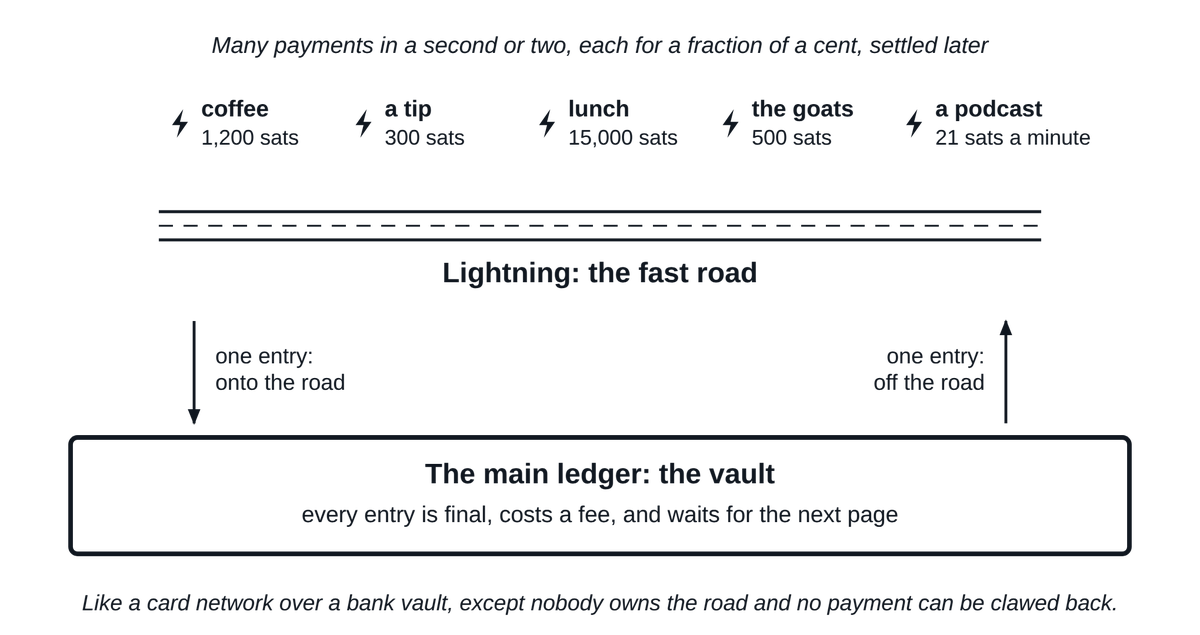
- I can describe how a Lightning payment works using the vault and fast-road picture, including why the ledger only sees the beginning and the end.
- I can convert a dollar amount to sats when I know the price.
- I can find a place near me that accepts Lightning and describe what happens at the register.
- I can say what the IRS calls it when I buy lunch with sats, and what record I need to keep.
Your brother-in-law says, “I’d never spend bitcoin. Every time you do, the IRS makes you fill out a form for a sandwich. It’s useless as money.” What do you say?
Say your answer out loud first. Then open the model response.
Show the model response
There is no form for each sandwich. Bitcoin is property for tax purposes, so spending it counts as selling, and each purchase can create a small gain or loss. You report them once a year, and most wallets and apps can export the list for you. Starting with the 2025 tax year, platforms also send Form 1099-DA. Whether bitcoin is good money yet is a fair argument. The tax rule only means keeping records, which a CPA can help with.
“If 92% of Salvadorans do not use it and every sandwich is a tax event, isn’t ‘spending bitcoin’ a hobby for enthusiasts?”
My answer
In the United States today, mostly, yes. Cards are convenient, the tax rules discourage small spending, and the number of places that accept bitcoin is small next to the number that accept cards. Most people who own bitcoin here hold it and rarely spend it, and I do not pretend otherwise.
Two things complicate the picture. First, the enthusiasts are not the point. Lightning’s clearest wins are where cards fail: the immigrant sending $200 home, the merchant losing 3% and a chargeback, the podcast host who gets paid a penny at a time by listeners who could never mail a penny. Those are people with a problem, and Lightning is a tool they use. The second is that infrastructure gets built before it is busy. Fedwire and the card networks took decades to become invisible. Lightning has run for eight years. Whether it becomes ordinary is a question no one can answer, and the way to hold it is as a tool you know how to use and have chosen, so far, not to use much.
Want a second opinion with sources? The Bitcoin Evidence Base answers claims like this one.
Watch, read, explore
Lightning Goats
Send a few sats and watch a feeder drop a treat. The Try it activity.lightning-goats.comExplore · 5 minPlaces that take bitcoin
A world map of shops and businesses, kept by volunteers.btcmap.orgProducts and services named are examples, not recommendations. I have no financial relationship with any of them.
The 26 notes for Chapter 12
- Bitcoin base-layer throughput, derived from block contents and the 10-minute target interval: in September 2026, blocks on mempool.space held roughly 2,300 to 5,000 transactions each, or about four to eight per second (mempool.space, recent blocks, retrieved September 2026); Nakamoto, “Bitcoin: A Peer-to-Peer Electronic Cash System,” 2008.
- Visa, “Fiscal 2025 Annual Report,” 2025 (329 billion payment and cash transactions in the fiscal year ended September 30, 2025, an average of 901 million per day, or more than 10,000 per second); Visa, “About Visa Fact Sheet,” visa.co.uk (capacity of “65,000+ transaction messages per second”), retrieved September 2026.
- Quiet-day fees: mempool.space showed every recommended fee tier at 1 sat per vB in late September 2026, roughly a dime for a typical transaction at the May 2026 price (mempool.space, retrieved September 2026). Crowded-day example: on April 20, 2024, the day of the fourth halving, the average fee paid per transaction reached a record of about $128 (Cointelegraph, “Bitcoin fees crash after record daily average of $128 on halving day,” citing YCharts, April 2024).
- SWIFT, “Discover Swift,” swift.com (“11,500+ connected institutions” in “220+ countries and territories”), retrieved September 2026.
- Federal Reserve Financial Services, “Fedwire Funds Service Operating Hours,” frbservices.org (funds-transfer business day runs from 9:00 p.m. ET on the preceding calendar day to 7:00 p.m. ET; closed Saturdays, Sundays and Reserve Bank holidays), retrieved September 2026. The Federal Reserve announced in October 2025 that it will add Sundays and weekday holidays in 2028 or 2029.
- Poon and Dryja, “Lightning Network,” presentation to SF Bitcoin Devs, February 23, 2015, lightning.network; Poon and Dryja, “The Bitcoin Lightning Network: Scalable Off-Chain Instant Payments,” draft 0.5.9.2, January 14, 2016; Lightning Labs, “Announcing our first Lightning mainnet release, lnd 0.4-beta!,” lightning.engineering, March 15, 2018.
- mempool.space, Lightning explorer statistics (public channel capacity of about 3,754 bitcoin across about 32,500 channels and 16,200 nodes as of August 30, 2026), retrieved September 2026.
- River, “The Lightning Network Grew by 1,212% in 2 Years,” river.com, October 2023 (an estimated 6.6 million Lightning payments in August 2023 against 503,000 in August 2021).
- Federal Reserve, Regulation II (debit interchange for covered issuers capped at 21 cents plus 0.05% of the transaction, plus a 1 cent fraud adjustment), federalreserve.gov, retrieved September 2026; Stripe, “Pricing,” stripe.com (2.9% plus 30 cents online, 2.7% plus 5 cents in person, for domestic cards), retrieved September 2026.
- BTC Map, “Dashboard,” btcmap.org (27,148 places listed, about 15,000 of them verified within the past year), retrieved September 2026; BTC Map, “2025 Annual Review,” blog.btcmap.org (21,823 places at the end of 2025).
- Steak ’n Shake, announcement of bitcoin acceptance, May 2025; Bitcoin Magazine, “Steak ’n Shake Now Accepting Bitcoin via Lightning Network Across U.S. Locations,” May 16, 2025.
- Typical published card processing rates: Stripe, “Pricing,” stripe.com (2.7% plus 5 cents in person; 2.9% plus 30 cents online), retrieved September 2026; Nilson Report, “Merchant Processing Fees in the United States, 2024,” 2025 ($187.20 billion in fees on $11.903 trillion of card purchase volume, about 1.6% averaged across credit and debit).
- Nilson Report, “Merchant Processing Fees in the United States, 2024,” nilsonreport.com, 2025 (U.S. merchants paid $187.20 billion in processing fees in 2024, up 8.7% from 2023), retrieved September 2026.
- Linthicum, “Welcome to Bitcoin Beach: How a California surfer brought cryptocurrency to a small village in El Salvador,” Los Angeles Times, June 26, 2021 (an anonymous American donor gave “more than $100,000” in bitcoin in 2019; Peterson declined to give the exact amount); CoinDesk, “Bitcoin Beach’s Pioneering Circular Economy Is Making a Global Impact,” April 17, 2023.
- Bitcoin Beach, bitcoinbeach.com, retrieved September 2026; CBS News, 60 Minutes, “Bitcoin Beach: How a town in El Salvador became a testing ground for bitcoin,” April 10, 2022 (the pupusa stand run by Mama Rosa was the first business to accept bitcoin).
- Bukele’s announcement by video to the Bitcoin 2021 conference in Miami, June 5, 2021 (CoinDesk, “President of El Salvador Says He’s Submitting Bill to Make Bitcoin Legal Tender,” June 5, 2021); El Salvador Legislative Assembly, Decreto Legislativo No. 57, Ley Bitcoin, dated June 8, 2021 and approved in the session of June 8 to 9, 2021, in force 90 days after publication, September 7, 2021.
- World Bank, Global Findex Database 2021 (35.9% of Salvadorans age 15 and over had an account at a financial institution or mobile money provider in 2021; 43.4% in 2024), data.worldbank.org, retrieved September 2026.
- World Bank, “Personal remittances, received (% of GDP), El Salvador” (26.3% in 2021; 24.3% in 2024), data.worldbank.org, retrieved September 2026.
- Instituto Universitario de Opinión Pública, Universidad Centroamericana José Simeón Cañas, “Encuesta de evaluación del año 2024,” Informe 177, survey of December 5 to 17, 2024, 1,266 interviews (91.8% said they had not used bitcoin in 2024), uca.edu.sv, January 2025; reported in El Diario de Hoy, “El 92% de salvadoreños no usó Bitcoin en 2024,” January 2025.
- International Monetary Fund, “IMF Reaches Staff-Level Agreement with El Salvador on an EFF Arrangement,” press release 24/485, December 18, 2024 (about US$1.4 billion; Executive Board approval February 26, 2025); El Salvador Legislative Assembly, reform of the Ley Bitcoin approved January 29, 2025, making acceptance voluntary (El Diario de Hoy, “Asamblea aprueba reforma a Ley Bitcoin,” January 29, 2025).
- Oficina Nacional de Bitcoin, El Salvador, reserve figures published at bitcoin.gob.sv (7,740 bitcoin in the second week of August 2026), as reported by Infobae, “Reserva de Bitcoin de El Salvador sube a 7,740 monedas,” August 12, 2026; International Monetary Fund, El Salvador, Country Report No. 25/190, July 2025 (increases in the reserve “reflect the consolidation of Bitcoin across various government-owned wallets”), imf.org, retrieved October 2026.
- Internal Revenue Service, Notice 2014-21, 2014; IRS “Digital Assets” guidance page.
- Internal Revenue Service, Topic No. 409, Capital Gains and Losses (long-term rates of 0, 15 and 20% by taxable income; net short-term gains taxed as ordinary income), irs.gov, retrieved September 2026; Publication 544.
- Internal Revenue Service, “Final regulations and related IRS guidance for reporting by brokers on sales and exchanges of digital assets,” T.D. 10000, June 2024 (gross proceeds reported for transactions on or after January 1, 2025; basis for certain transactions on or after January 1, 2026), irs.gov, retrieved September 2026; IRS, “Understanding your Form 1099-DA,” irs.gov, retrieved September 2026.
- Virtual Currency Tax Fairness Act, H.R. 6582 and S. 4608 (117th Congress, 2022) and S. 4808 (118th Congress, 2024); S. 2207 (119th Congress), introduced by Sen. Lummis in June 2025 with a $300 per-transaction exclusion. None had been enacted as of August 2026: The Tax Adviser, “Tax legislation for digital assets: What’s the conversation in Congress?,” August 2026.
- Lightning Goats, lightning-goats.com (live YouTube camera; “Send treats using the QR code in the video”), retrieved September 2026.
Found a broken link or a mistake? Write to [BOOK EMAIL] and I will fix it.