Scams, frauds and red flags
“An ounce of prevention is worth a pound of cure.”Benjamin Franklin, Pennsylvania Gazette, 1735.This page in the book: yourbitcoinbasics.com/ch11
Bitcoin, right now
No price chart here on purpose. Chapter 6 covers price.
By the end of Chapter 11
Do it on your phone or laptop
- Find one in your own inbox. About 15 minutes on a phone.
- Search your email or text messages for “account,” “verify,” or “wallet.” Find one message you did not ask for about a problem or an offer, crypto or otherwise. Almost everyone has one. Hold it against the red-flag page and count the flags it hits. Then delete it.
- If that message claimed to be from a company you actually use, type the company’s web address yourself, find its help page on how it contacts customers, and read what it says it will never do.
- Say the pause line aloud to one person: “Let me talk to my family and call you back.” Then text that person one line: “If I ever call you about money in a hurry, ask me who is rushing me.”
- Bookmark ic3.gov and reportfraud.ftc.gov on your phone. You will not want to be searching for them on a bad day.
- If you hold bitcoin with a company, open its app from your home screen, never from a link, and find the screen where you would withdraw. Do not withdraw anything. Knowing where the door is takes the fear out of a call that says the door is locked.
Got a message right now? Paste it into the scam check. It finds the flags for you.
Did it stick?
Rate yourself: yes, mostly, or not yet. Not yet means reread that section. It does not mean you failed.
- I can name at least six of the nine kinds of scams and say the tell for each.
- I can say the two things every scam is after.
- I can explain the difference between the Bitcoin network being hacked and an exchange failing, with one example of each claim’s record.
- I can say the pause line and the callback rule from memory.
- I can list the first three things to do if someone I love has been scammed.
Your mother calls, excited. A man she has been talking to online for two months has been showing her how he trades bitcoin, and she wants you to help her set up an account on his platform tonight because the window closes Friday. What do you say?
Say your answer out loud first. Then open the model response.
Show the model response
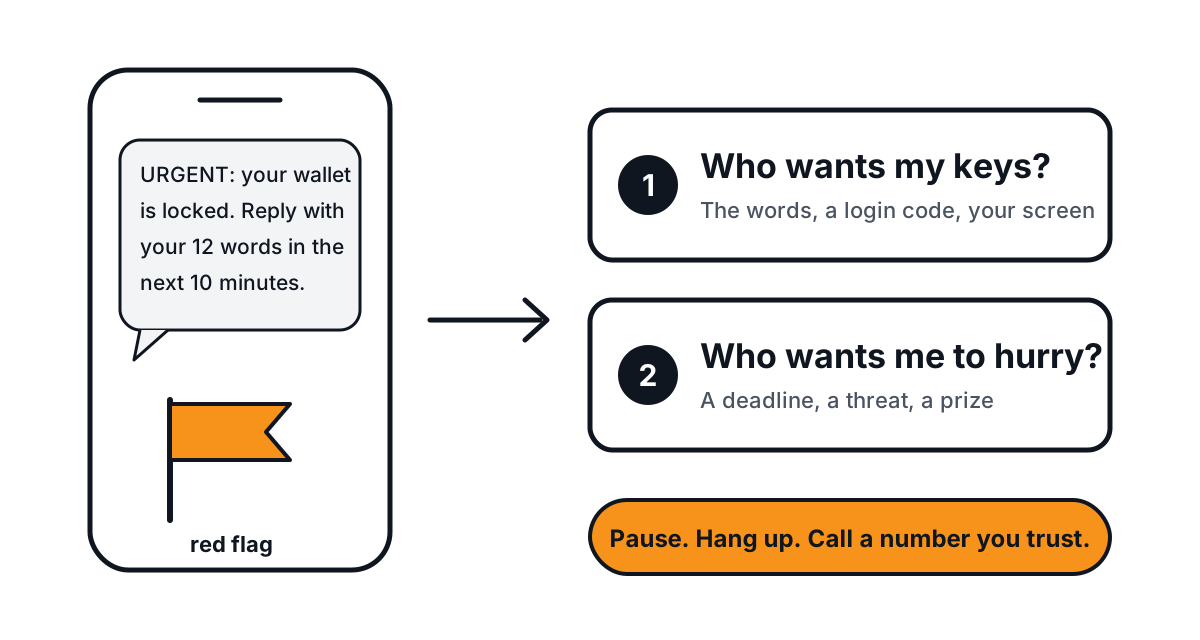
Mom, please do not send anything tonight. Let us talk first. A deadline, a new friend you have only met online, and a trading site he picked for you are three red flags at once. This is the scam called pig butchering: someone builds trust for weeks, shows fake profits on a fake site, and then takes everything. A real opportunity does not close on Friday. Do not move money, and do not share any codes or recovery words. We can report it together at ic3.gov and reportfraud.ftc.gov.
“If Bitcoin attracts this many scams, doesn’t that tell you something about Bitcoin?”
My answer
It tells you two true things. Bitcoin is valuable, and Bitcoin payments can't be reversed. Thieves go where the value is, and scammers ask to be paid in whatever cannot be clawed back. That is why the FTC’s fraud losses are led by bank transfers, crypto, wire transfers, and gift cards, in that order in 2024 and another order in other years. Nobody proposes closing the banks because bank transfers lead the list.
It also tells you something less flattering, and I will not spin it. The world around bitcoin has been worse than most. It grew fast with no gatekeeper; the word “crypto” drew in thousands of tokens built to be sold, and for years the culture tolerated giveaways, pumps, and guaranteed-yield lenders as if they were part of the same project. They were parasites on it. The public ledger has made some of those people easy to catch, and the collapses of 2022 cleared a good deal out, but a beginner still walks into a field with more traps than a brokerage account has. This chapter exists because that is true.
And finality cuts both ways. No one can reverse a payment you regret, and no one can reverse a payment a thief regrets either.
Want a second opinion with sources? The Bitcoin Evidence Base answers claims like this one.
Watch, read, explore
Report internet fraud
The FBI’s Internet Crime Complaint Center. Bookmark it now.ic3.govExplore · 2 minReport fraud to the FTC
The Federal Trade Commission’s reporting site.reportfraud.ftc.govRead · 5 minCryptocurrency and scams
The FTC’s plain list of the scams it sees most.consumer.ftc.govProducts and services named are examples, not recommendations. I have no financial relationship with any of them.
The 22 notes for Chapter 11
- FBI Internet Crime Complaint Center, 2024 Internet Crime Report, April 2025, ic3.gov, retrieved September 2026 (cryptocurrency-related losses of $9.3 billion; losses by complainants over 60 of $4.9 billion, of which $2.8 billion was cryptocurrency-related).
- Federal Trade Commission, Consumer Sentinel Network Data Book 2024, March 2025, ftc.gov, retrieved September 2026 (2024 losses by payment method: bank transfer or payment $2.09 billion, cryptocurrency $1.42 billion, wire transfer $391 million, gift or reload card $287 million); Federal Trade Commission, “Who Experiences Scams? A Story for All Ages,” data spotlight, December 2022; Federal Trade Commission, annual report to Congress on protecting older consumers, December 2025, ftc.gov, retrieved September 2026.
- Ledger, “Addressing the July 2020 E-commerce and Marketing Data Breach,” ledger.com, July 2020; Ledger, “Message by Ledger’s CEO: Update on the July Data Breach,” ledger.com, December 21, 2020, retrieved September 2026 (approximately 272,000 customers’ names, postal addresses and phone numbers published December 20, 2020); CoinDesk, “Scammers Are Sending Ledger Users Fake Hardware Wallets,” June 17, 2021.
- United Nations Office of the High Commissioner for Human Rights, Online Scam Operations and Trafficking into Forced Criminality in Southeast Asia, 2023; FBI IC3 public service announcement on cryptocurrency investment fraud, 2023.
- Coinbase Help Center, “Technical Support and Impersonation Scams,” help.coinbase.com, retrieved September 2026; Kraken Support, “Protect Yourself from Scams,” support.kraken.com, retrieved September 2026; Kraken, “How to Verify a Call Is Really from Kraken Support,” blog.kraken.com, retrieved September 2026.
- FBI Internet Crime Complaint Center, “Criminals Increasing SIM Swap Schemes to Steal Millions of Dollars from US Public,” public service announcement I-020822-PSA, February 8, 2022, ic3.gov, retrieved September 2026 (1,611 complaints and adjusted losses of more than $68 million in 2021).
- Federal Trade Commission, “Refund and Recovery Scams,” consumer.ftc.gov, December 2023, updated August 2026, retrieved September 2026.
- Atlantic Council Digital Forensic Research Lab, “Crypto-Scam Hosts Pop-Up Livestream Featuring a Deepfaked Elon Musk,” dfrlab.org, September 25, 2024, retrieved September 2026 (June 18, 2024 YouTube livestream that ran more than seven hours); Michael Saylor, statement on X, January 13, 2024, as reported in Decrypt, “Michael Saylor Sounds Alarm on Deepfake Bitcoin Scams,” January 2024, retrieved September 2026.
- Federal Trade Commission, “Scammers use AI to enhance their family emergency schemes,” consumer alert, March 2023.
- U.S. Department of Justice, “BitConnect Founder Indicted in Global $2.4 Billion Cryptocurrency Scheme,” press release, February 25, 2022, justice.gov, retrieved September 2026; SEC v. BitConnect et al., complaint filed 2021.
- Securities and Exchange Commission, “SEC Charges Kim Kardashian for Unlawfully Touting Crypto Security,” press release 2022-183, October 3, 2022, sec.gov, retrieved September 2026 ($1.26 million total, of which a $1 million penalty and about $260,000 in disgorgement and interest; $250,000 promotional payment).
- Satoshi Nakamoto, “Strange block 74638,” bitcointalk.org, August 15, 2010; Bitcoin commit d4c6b90, “fix for block 74638 overflow output transaction,” github.com/bitcoin/bitcoin, August 15, 2010, released as Bitcoin 0.3.10, retrieved September 2026.
- Andreas M. Antonopoulos, “Your keys, your Bitcoin. Not your keys, not your Bitcoin,” quoted in Cointelegraph, August 10, 2016, after the Bitfinex hack, retrieved September 2026; Antonopoulos popularized the line, and no earlier documented origin was found.
- Kraken, “Proof of Reserves,” kraken.com, retrieved September 2026; Public Company Accounting Oversight Board, “Investor Advisory: Exercise Caution with Third-Party Verification/Proof of Reserve Reports,” March 8, 2023, pcaobus.org, retrieved September 2026.
- U.S. Department of Justice, “Three Individuals Charged for Alleged Roles in Twitter Hack,” press release, July 31, 2020, justice.gov, retrieved September 2026 (more than 400 transfers worth more than $100,000); Hillsborough County State Attorney’s Office, Florida, charges against Graham Ivan Clark, 17, announced July 31, 2020, as reported by CBS News, July 31, 2020.
- Federal Trade Commission, “Romance Scammers’ Favorite Lies Exposed,” data spotlight, February 9, 2023 ($1.3 billion reported lost in 2022); Federal Trade Commission, “Love Stinks When a Scammer Is Involved,” business blog, February 13, 2024 ($1.14 billion reported lost in 2023), ftc.gov, retrieved September 2026.
- Peter M. Gollwitzer, “Implementation Intentions: Strong Effects of Simple Plans,” American Psychologist 54, no. 7 (1999): 493-503; Robert B. Cialdini, Raymond R. Reno and Carl A. Kallgren, “A Focus Theory of Normative Conduct: Recycling the Concept of Norms to Reduce Littering in Public Places,” Journal of Personality and Social Psychology 58, no. 6 (1990): 1015-1026; Richard H. Thaler and Cass R. Sunstein, Nudge (Yale University Press, 2008).
- U.S. Department of Justice, “Two Arrested for Alleged Conspiracy to Launder $4.5 Billion in Stolen Cryptocurrency,” press release, February 8, 2022, justice.gov, retrieved September 2026 (over 94,000 of the 119,754 bitcoin stolen from Bitfinex in 2016).
- AARP Fraud Watch Network Helpline, 877-908-3360, aarp.org, retrieved September 2026; Eldercare Locator for state Adult Protective Services offices.
- Tax Cuts and Jobs Act of 2017, personal casualty and theft loss limits for 2018 through 2025; IRS Office of Chief Counsel, memorandum 202511015, “Allowance of Theft Losses for Victims of Scams Under I.R.C. Section 165,” dated January 17, 2025, released March 14, 2025, irs.gov, retrieved September 2026. The memorandum concluded that a victim who sent money to a scam platform intending to earn a profit may claim a theft loss under section 165(c)(2), which the 2018 suspension does not reach, while a victim of a romance or impersonation scam with no profit motive may not. The 2025 budget law made the suspension of personal casualty losses permanent (One Big Beautiful Bill Act, Public Law 119-21, July 4, 2025; IRS, “Casualty loss deduction expanded and made permanent,” irs.gov, updated September 15, 2026; from 2026, losses in state-declared disasters also qualify).
- Federal Trade Commission, Consumer Sentinel Network Data Book 2024, romance scam losses by gender and age, ftc.gov, retrieved September 2026.
- Federal Trade Commission, “Scammers use AI to enhance their family emergency schemes,” consumer alert, March 2023; FBI Internet Crime Complaint Center, public service announcement on criminal use of generative AI, December 3, 2024, ic3.gov, retrieved September 2026.
Found a broken link or a mistake? Write to ybbook@proton.me and I will fix it.